


Replies and threads
What users get
Any message can start a thread: a conversation of replies under it, shown in its own panel. Users also get a thread list with every thread they take part in, and can send a reply to the channel as well.
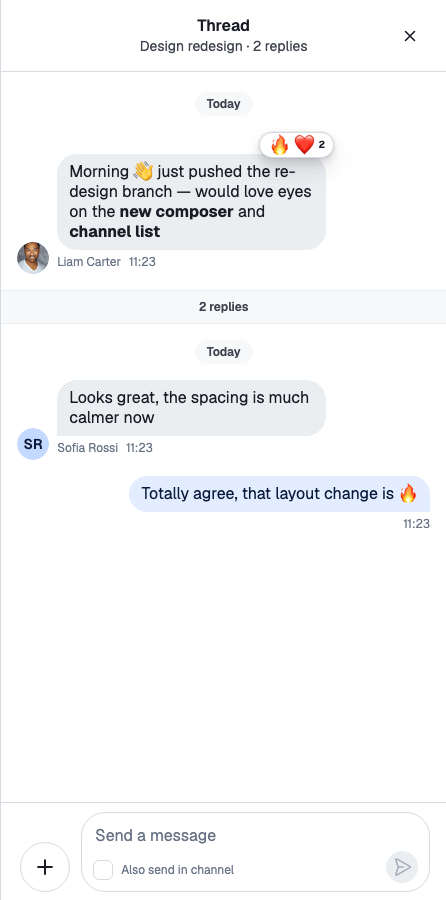
- Starting and opening a thread. The reply button on a message, or Thread Reply in its menu, opens the message's thread. A message with replies shows a reply count button with the avatars of the people who replied.
- The thread panel. The header shows "Thread", the channel's name and the number of replies, and who is typing. The parent message sits at the top, followed by a reply count divider, the replies and a composer.
- Also sending to the channel. The thread's composer has an "Also send in channel" checkbox ("Also send as a direct message" in a one-to-one channel). Such a reply shows "Also sent in channel · View" in the thread, and "Replied to a thread · View" in the channel. View jumps to the other copy.
- The thread list. A list of the user's threads, each with its parent message, latest reply and unread count. When threads that aren't in the list get new replies, a banner offers to reload it. With
ChatView, the threads button shows the number of unread threads.
How it works across the layers
State: a thread and its replies
A reply is a message with a parent_id, and a thread is identified by its parent message: thread.id is the parent message's id. The client keeps one Thread per thread, shared by every component that shows it: client.threads.ensure({ channel, parentMessage }) returns it. Like a channel, it has thread.messagePaginator for the replies, thread.messageComposer and thread.messageOperations; Parent message and replies explains what it holds and when it loads.
UI: the thread panel
<Thread/> renders the thread passed as thread and provides it to its children: <ThreadHeader/>, <MessageList/> for the parent message and the replies, and <MessageComposer/> with the "Also send in channel" checkbox. The Thread component explains what it does.
With <ChatView/>, the reply button and the Thread Reply action call openThread({ channel, message }) from useWorkspaceNavigation(), and <ThreadSlot/> renders the thread. The Quick start builds this layout. Every way of opening a thread, and the View links of replies sent to the channel, are on Moving between channels, threads and messages.
The thread's message list marks it read when the user reaches its latest reply; see Read state, unread and receipts.
The thread list
The thread manager, client.threads, loads the user's threads in its paginator and keeps the unread thread count, even while no thread list is on screen. <ThreadList/> renders the threads in the server's order. A new reply updates a thread's row in place, and a reply in a thread that isn't in the list shows the unseen threads banner; clicking it reloads the list. A reload asks for as many threads as are loaded plus the unseen ones, up to one page.
- State: The user's threads.
- UI: Thread list UI.
- API: Thread and thread manager.
Turning it on or off
Replies are on by default. Two settings must both allow them:
- On the client:
channel.replies.enabledinclient.config. - On the server: the channel type's
repliessetting, in the dashboard. When the server turns replies off, the client can't turn them on.
client.config.set({ channel: { replies: { enabled: false } } });Check channel.config.replies.enabled for the value in effect. When it's false, Thread renders nothing.
The send-reply capability decides who can reply. Without it, the message actions leave out the reply button and Thread Reply. The actions check only the capability, so when you turn replies off on the client, remove the reply actions too; see Actions.
Customizing
Composing the thread panel
Thread and ThreadSlot render their children, so the panel is whatever you put inside: your own header, a VirtualizedMessageList instead of MessageList, or extra content. See Thread UI.
Replacing the parent message area
ThreadHead renders the parent message, and ThreadStart the divider under it. Both are override keys. This divider names how many people replied:
import type { ThreadState } from "stream-chat";
import {
  useStateStore,
  useThreadContext,
  WithComponents,
} from "stream-chat-react";

const parentSelector = (state: ThreadState) => ({
  participants: state.participants,
  replyCount: state.replyCount,
});

const RepliesStart = () => {
  const thread = useThreadContext();
  const { participants, replyCount } =
    useStateStore(thread?.state, parentSelector) ?? {};

  if (!replyCount) return null;

  return (
    <div className="str-chat__thread-start">
      {replyCount} replies from {participants?.length ?? 0} people
    </div>
  );
};

export const App = () => (
  <WithComponents overrides={{ ThreadStart: RepliesStart }}>
    {/* the rest of the app */}
  </WithComponents>
);
Replacing a thread list row
ThreadListItemUI renders one row of the thread list. A replacement reads its thread with useThreadListItemContext() and opens it with openThread:
import type { ThreadState } from "stream-chat";
import {
  useChatContext,
  useStateStore,
  useThreadListItemContext,
  useWorkspaceNavigation,
  WithComponents,
} from "stream-chat-react";

const rowSelector = (state: ThreadState) => ({
  parentMessage: state.parentMessage,
  read: state.read,
  replyCount: state.replyCount,
});

const CompactThreadRow = () => {
  const thread = useThreadListItemContext();
  const { client } = useChatContext();
  const { isThreadActive, openThread } = useWorkspaceNavigation();
  const { parentMessage, read, replyCount } =
    useStateStore(thread?.state, rowSelector) ?? {};

  if (!thread || !parentMessage) return null;

  const unreadCount = read?.[client.userId ?? ""]?.unreadMessageCount ?? 0;

  return (
    <button
      aria-pressed={isThreadActive(thread.id)}
      className="compact-thread-row"
      onClick={() => openThread(thread)}
      type="button"
    >
      <span>{parentMessage.text}</span>
      <span>{replyCount} replies</span>
      {unreadCount > 0 && <strong>{unreadCount} new</strong>}
    </button>
  );
};

export const App = () => (
  <WithComponents overrides={{ ThreadListItemUI: CompactThreadRow }}>
    {/* the rest of the app */}
  </WithComponents>
);ThreadListItem, ThreadListUnseenThreadsBanner, ThreadListEmptyPlaceholder and ThreadListLoadingIndicator are override keys too.
Threads without ChatView
Without a layout, openThread does nothing, so the reply button opens nothing. Provide your own navigation with WorkspaceNavigationProvider, keep the open thread in state, and render it with Thread:
import { useMemo, useState } from "react";
import { Thread as StreamThread } from "stream-chat";
import type { Channel as StreamChannel } from "stream-chat";
import {
  Channel,
  defaultWorkspaceNavigation,
  MessageComposer,
  MessageList,
  Thread,
  ThreadHeader,
  useChatContext,
  WorkspaceNavigationProvider,
} from "stream-chat-react";
import type { WorkspaceNavigation } from "stream-chat-react";

export const ChannelWithThreads = ({ channel }: { channel: StreamChannel }) => {
  const { client } = useChatContext();
  const [thread, setThread] = useState<StreamThread>();

  const navigation = useMemo<WorkspaceNavigation>(
    () => ({
      ...defaultWorkspaceNavigation,
      closeThread: () => setThread(undefined),
      isThreadActive: (threadId) => threadId === thread?.id,
      isThreadDismissable: () => true,
      openThread: (target) =>
        setThread(
          target instanceof StreamThread
            ? target
            : client.threads.ensure({
                channel: target.channel,
                parentMessage: target.message,
              }),
        ),
      openThreads: thread ? [thread] : [],
    }),
    [client, thread],
  );

  return (
    <WorkspaceNavigationProvider value={navigation}>
      <Channel channel={channel}>
        <MessageList />
        <MessageComposer />
      </Channel>
      {thread && (
        <Thread thread={thread}>
          <ThreadHeader />
          <MessageList />
          <MessageComposer />
        </Thread>
      )}
    </WorkspaceNavigationProvider>
  );
};
client.threads.ensure() returns the one instance for the thread, so the list and the panel share it. The close button of ThreadHeader calls closeThread. See Providing your own navigation.
Showing the unread thread count
client.threads.state.unreadThreadCount holds the number of threads with unread replies. Read it with useStateStore, as the example in What's new in v15 does.
Reference
- State: What channels and threads hold, Message paginators and Thread and thread manager.
- UI: Thread UI, Thread list UI, Moving between channels, threads and messages and Workspace with ChatView.
- Props: Thread, ThreadList, ThreadListItem, ThreadContext and ChatView components for
ThreadSlotandThreadListSlot. - Hooks: Channel and thread hooks.