
 React
React iOS
iOS Android
 Flutter
 Angular
 JavaScript
 Unity
Unity Unreal
 Node
Node Python
 Ruby
Ruby PHP
PHP Java
Java .NET
.NET Go
Go REST
RESToverride fun onCreate(savedInstanceState: Bundle?) {
super.onCreate(savedInstanceState)
setContent {
ChatTheme {
ChannelList(modifier = Modifier.fillMaxSize())
}
}
}Channel List
The ChannelList component allows you to build a paginated list of Channel items with exposed long tap and single tap actions. We provide two versions of the ChannelList component:
- Bound: Binds to a
ChannelListViewModeland loads all required data automatically. Connects long item tap and pagination events to theViewModel. - Stateless: Doesn't depend on a
ViewModel. Instead, it takeschannelsStateandcurrentUseras parameters for rendering.
You can learn more about the different component types on the Component Architecture page.
The bound version uses the stateless version internally. When providing the same state to either component, the behavior is identical.
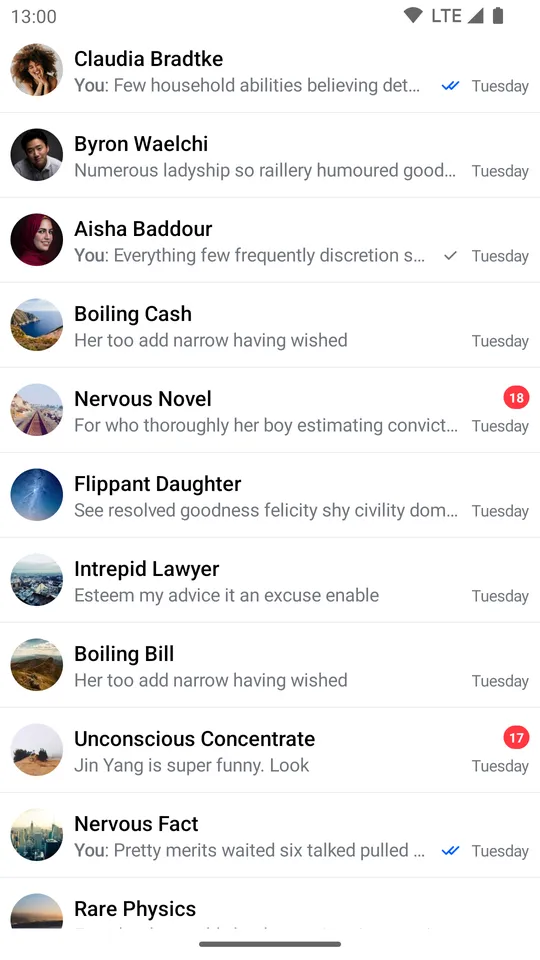
Based on the provided state, the component shows the following UI:
- Loading indicator: When loading the initial data.
- Empty content: When loading is complete but there are no channels.
- Empty search content: When a search query returns no results.
- Channel list: The paginated list of channels.
Let's see how to show a list of channels.
Usage
To use the bound ChannelList, add it to your UI within setContent():
This basic example shows a paginated list of channels. The default ChannelListViewModel is created automatically with:
- Sort order:
QuerySortByField.descByName("last_updated") - Filters:
null(shows all channels the user is a member of)
We recommend passing in action handlers to react to item taps, or providing a custom ChannelListViewModel instance.
The snippet above will generate the following UI.
 |
|---|
Let's see how to handle actions and use the ViewModel.
Handling Actions
If you've chosen the bound version of the ChannelList component, we recommend either providing your own instance of the ViewModel, or overriding default actions to react to state changes. To support that, the ChannelList signature exposes the following parameters:
@Composable
fun ChannelList(
    viewModel: ChannelListViewModel = viewModel(
        factory = ... // Our default factory
    ),
    onLastItemReached: () -> Unit = { viewModel.loadMore() },
    onChannelClick: (Channel) -> Unit = {},
    onChannelLongClick: (Channel) -> Unit = { viewModel.selectChannel(it) },
    onSearchResultClick: (Message) -> Unit = {},
    ... // Content Slots
)viewModel: The instance of theChannelListViewModelthat this component reads data from and sends events to. Pass in your own instance if you want more control over your business logic, such as changingChannelfilters or sort order in runtime.onLastItemReached: Handler when the user reaches the last item in the list to trigger pagination. You don't need to override this if you're using the defaultviewModel, but if you're using a custom one, you can add custom behavior.onChannelClick: Handler when the user taps on an item. Useful for starting theMessagesScreen.onChannelLongClick: Handler when the user long taps on an item. By default, this updates state in theviewModel, which you can read to show custom UI andChannelactions if you're using a customViewModelinstance. Override if you're using the defaultviewModeland you want to change the behavior.onSearchResultClick: Handler when the user taps on a search result item. Useful for starting theMessagesScreenwith the selected message.
Here's an example of using the default ViewModel, but overriding the behavior:
override fun onCreate(savedInstanceState: Bundle?) {
    super.onCreate(savedInstanceState)

    setContent {
        ChatTheme {
            // Custom state holder
            var selectedChannel by remember { mutableStateOf<Channel?>(null) }

            Box(modifier = Modifier.fillMaxSize()) {
                ChannelList(
                    modifier = Modifier.fillMaxSize(),
                    onChannelLongClick = { // Custom long tap handler
                        selectedChannel = it
                    },
                    onChannelClick = {
                        // Start the MessagesScreen
                    },
                    onSearchResultClick = {
                        // Start the MessagesScreen with the selected message
                    }
                )

                if (selectedChannel != null) {
                    // Show custom UI
                }
            }
        }
    }
}
In the example above, we created a selectedChannel state holder, which we use to show some custom UI if the data is not null. We update the state when the user long taps on an item.
We also provide a custom onChannelClick handler, to open the MessagesScreen with the selected item. This will produce the same UI, but with user-defined actions.
Finally we provide a custom onSearchResultClick handler, to open the MessagesScreen with the selected message.
Alternatively, you can override the default ViewModel and read the internal state:
val listViewModel: ChannelListViewModel by viewModels { ChannelViewModelFactory() }

override fun onCreate(savedInstanceState: Bundle?) {
    super.onCreate(savedInstanceState)

    setContent {
        ChatTheme {
            Box(modifier = Modifier.fillMaxSize()) {
                ChannelList(
                    modifier = Modifier.fillMaxSize(),
                    viewModel = listViewModel, // Passing in our ViewModel
                    onChannelClick = {
                        // Start the MessagesScreen
                    },
                    onSearchResultClick = {
                        // Start the MessagesScreen with the selected message
                    },
                )

                if (listViewModel.selectedChannel != null) {
                    // Show custom UI
                }
            }
        }
    }
}
The behavior will be the same and you gain more control over the ViewModel.
We recommend that you create an instance of our ViewModel if you're thinking of using our predefined state and operations. If you're looking into a more low-level solution, with more control, you can use the stateless version of our components.
To customize how real-time events affect the channel list (e.g., when using multiple lists filtered by channel type), see Channels State and Filtering.
Controlling the scroll state
You can control the scroll state of the channel list by providing a lazyListState parameter, like in the example below:
@Composable
fun ChannelList(
    ..., // State
    lazyListState: LazyListState = rememberLazyListState(),
    ... // Actions & Content Slots
)lazyListState: The scroll state of the list. While not a handler, you can use it to control the scroll and trigger custom scroll actions.
To customize this state you can simply pass your own instance as a parameter:
val lazyListState = rememberLazyListState()

ChannelList(
    // State
    lazyListState = lazyListState
    // Actions & Content Slots
)
Customization
The ChannelList exposes several content slots for UI customization:
@Composable
fun ChannelList(
    // State and action handlers
    modifier: Modifier = Modifier,
    contentPadding: PaddingValues = PaddingValues(),
    lazyListState: LazyListState = rememberLazyListState(),
    loadingContent: @Composable () -> Unit = { /* Default loading indicator */ },
    emptyContent: @Composable () -> Unit = { /* Default empty state */ },
    emptySearchContent: @Composable (String) -> Unit = { /* Default empty search state */ },
    helperContent: @Composable BoxScope.() -> Unit = { /* Empty by default */ },
    loadingMoreContent: @Composable LazyItemScope.() -> Unit = { /* Default pagination loader */ },
    channelContent: @Composable LazyItemScope.(ItemState.ChannelItemState) -> Unit = { /* Default channel item */ },
    searchResultContent: @Composable LazyItemScope.(ItemState.SearchResultItemState) -> Unit = { /* Default search item */ },
    divider: @Composable LazyItemScope.() -> Unit = { /* Default divider */ },
)modifier: Modifier for the root component. Apply background, elevation, padding, shape, or touch handlers.contentPadding: Padding values applied around the list content.lazyListState: Controls the scroll state of the list. Useful for implementing scroll-to-top functionality.loadingContent: Displayed when loading the initial data.emptyContent: Displayed when there are no channels.emptySearchContent: Displayed when a search query returns no results. Receives the search query as a parameter.helperContent: Overlay content for the list. Empty by default, but useful for scroll-to-top buttons or other floating UI.loadingMoreContent: Displayed at the bottom of the list when loading the next page.channelContent: Customizes channel item rendering. ReceivesItemState.ChannelItemStatecontaining the channel and typing users.searchResultContent: Customizes search result item rendering. ReceivesItemState.SearchResultItemStatecontaining the message and channel.divider: Customizes the divider between items.
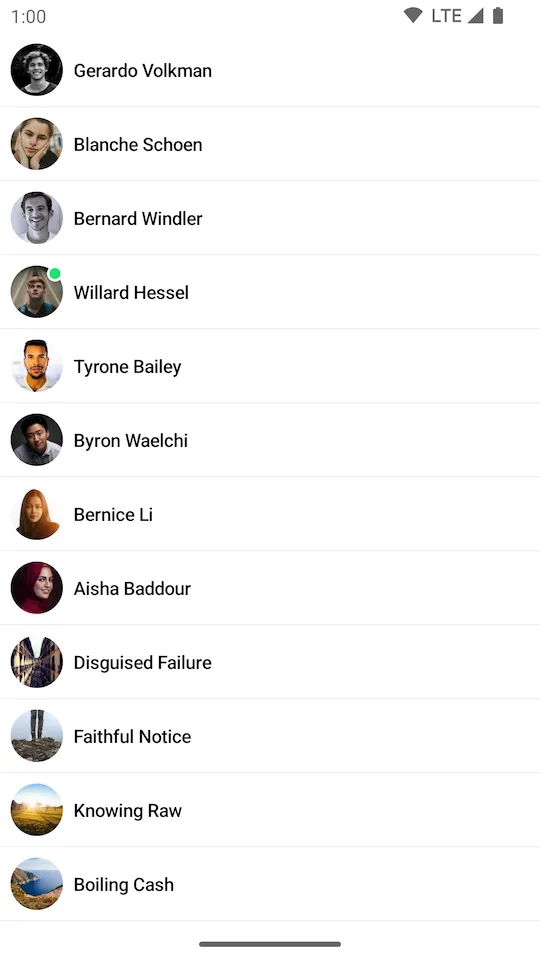
Here's a simple example for building your own channel item, by overriding the channelContent parameter:
val user by listViewModel.user.collectAsState() // Fetch user

ChannelList(
    ..., // Set up state
    channelContent = { // Customize the channel items
        Row(
            modifier = Modifier
                .padding(8.dp)
                .fillMaxWidth(),
            verticalAlignment = Alignment.CenterVertically
        ) {
            ChannelAvatar(
                modifier = Modifier.size(40.dp),
                channel = it.channel,
                currentUser = user
            )

            Spacer(modifier = Modifier.width(8.dp))

            Text(
                text = ChatTheme.channelNameFormatter.formatChannelName(it.channel, user),
                style = ChatTheme.typography.bodyBold,
                maxLines = 1,
            )
        }
    }
)
The snippet above will generate the following UI:
 |
|---|
As you can see, the items now show just the image and the channel name. You can customize the items to any extent, whatever your design specification might require.
And you can customize the emptyContent and the loadingContent to your needs if you need custom UI there.