
10 Most Secure Messaging Apps - The Best Platforms & Solutions


Messaging apps make it easy to chat and connect with people around the world. But with new ways to communicate come new ways for your privacy and security to be breached.
Private messages could be read by third parties, the organizations behind the apps, or governments that collect private information about their citizens.
And not every popular app protects your messages the same way. Instagram discontinued its end-to-end encrypted DM option in May 2026, and Meta now tells users who want encryption to use WhatsApp instead.
The apps on this list take a more thorough approach to security. Each uses end-to-end encryption as a core feature, a method that prevents anyone but you and the intended recipient from reading a message's contents, including the app maker itself.
What is Secure Messaging?
Secure messaging can involve many elements, but a few factors matter most when judging whether an app qualifies as genuinely secure:
-
End-to-end encryption: End-to-end encryption (E2EE) encrypts a message so that only the participants in the conversation can read it, excluding internet service providers, the app maker, the government, or anyone else. From the moment a message is typed to the moment it's received, no one else can see its contents.
If an app isn't end-to-end encrypted, treat it as non-private.
Keep in mind that E2EE protects the content of a message from the server, not necessarily its existence. Many E2EE apps still store encrypted copies on their servers to support offline delivery or multi-device syncing. What E2EE guarantees is that the server can't read what's stored, not that nothing is stored at all.
-
Forward secrecy: Forward secrecy adds a further layer. Encryption keys change with each message, so if a single key is ever compromised, past messages stay protected. An app can be end-to-end encrypted without forward secrecy, which is a weaker guarantee.
-
Multi-mode messaging: Multi-mode communication lets users send messages as text, video, or audio, and typically allows them to delete any of those message types after sending.
-
Cross-platform synchronization: Cross-platform synchronization keeps conversations available across mobile, web, and desktop. For users who prefer to store messages on one device and delete them from another, this also supports better control over their own data.
Features To Consider When Selecting a Service
In addition to the key security features listed above, look out for:
- Minimal metadata collection: Even if message content is encrypted, records of who you talked to and when can reveal a lot. Apps that limit this collection offer stronger privacy overall.
- No phone number required to sign up: Reduces the amount of personal information tied to your account and makes it harder to link your identity to your messages.
- Self-hosting or decentralized infrastructure: Lets an organization or individual run their own server instead of depending on one company's infrastructure.
- Disappearing messages: Automatically deletes messages after a set time, limiting how long sensitive information exists anywhere.
- Independence from big tech companies: Reduces reliance on companies whose business models may depend on user data.
- Open source code: Lets independent security researchers inspect how an app actually works, rather than taking its privacy claims on faith.
The Best Apps for Secure Communication
There are numerous viable options for choosing a secure messaging program that emphasizes data privacy. We have created a list of the best, most reliable messaging apps that keep your information secure and confidential.
Here is our take on the best secure messaging apps on the market today:
1. Signal Private Messenger
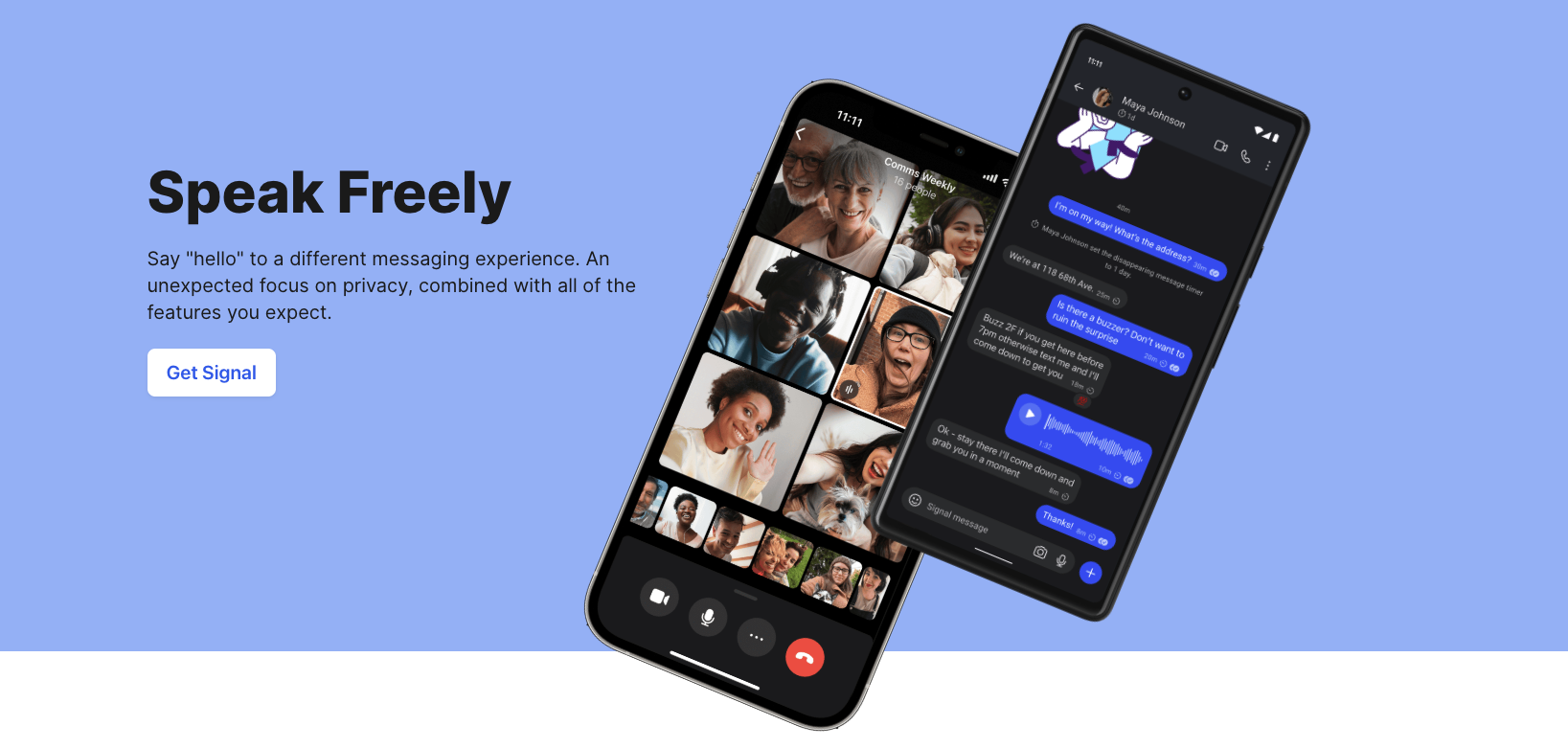
Millions of people use Signal for instant, free, and encrypted communication because it's known as one of the most secure messaging apps on the market. It's a cross-platform encrypted messaging service dedicated to end-to-end encrypted voice calling and encrypted texting.
Signal secure messaging is one of the few apps that keep their privacy-preserving technology always enabled; this default setting ensures there is never a risk of sharing moments or sending messages to unintended recipients.
For added security, users can choose different disappearing message intervals for each conversation saved in their chat history.
Signal is an open-source project supported by donations and grants, so there are no advertisements, no affiliate marketers, and no secret tracking. Signal doesn't have the keys to decrypt messages, so the company will never have access to the content its users are exchanging.
Features
- Open source protocol
- Self-destructing messages after a given time frame
- Uses phone's data connection to void SMS and MMS fees
- Encrypted stickers
- Group chat
- View-once media
Cost: Free, with no ads.
Number of users: 70 - 100 million monthly active users, according to Signal's Foundation president. Downloads are at 218+ million.
2. Wire
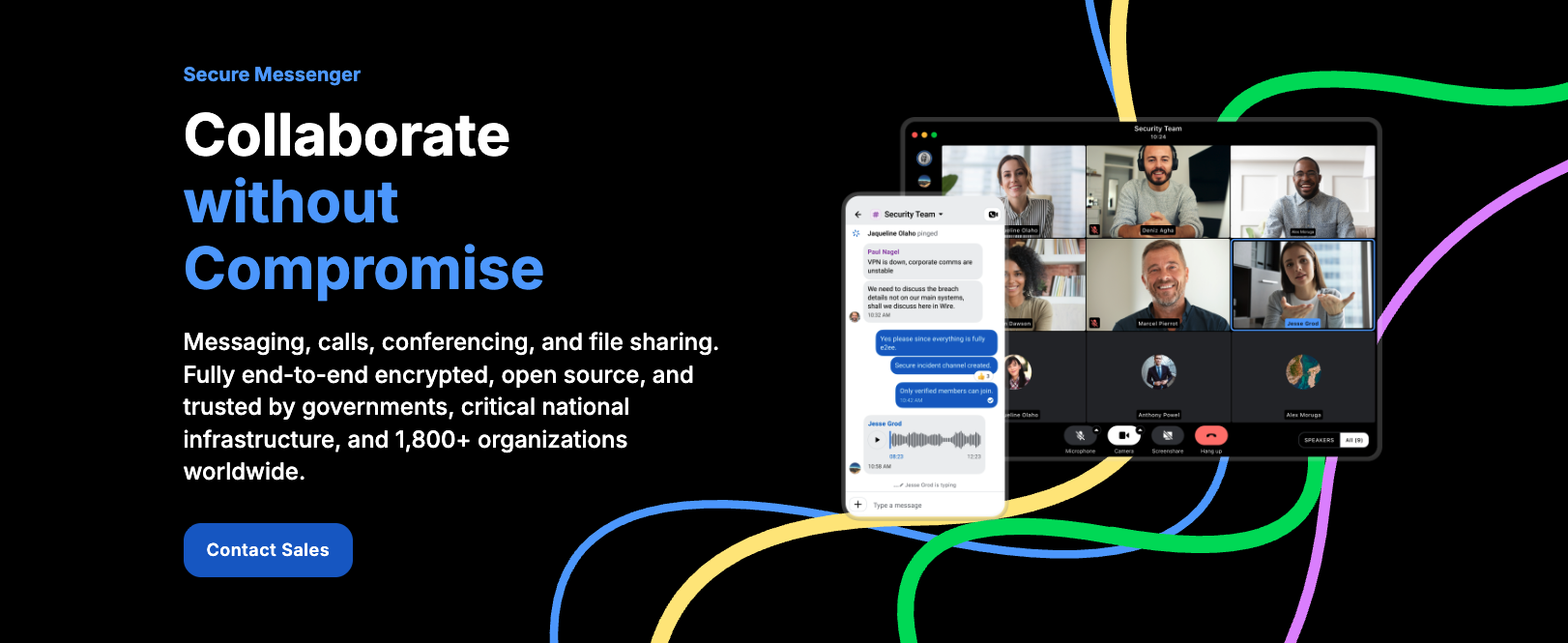
Another secure chat app option is Wire. Wire sets end-to-end encryption as the default across messages, calls, and files, and it can't be turned off.
Its core client and server code are open source under GPL-3.0 and AGPL-3.0 licenses, available on GitHub for anyone to inspect. Enterprise features like on-premises deployment, single sign-on, and federation, however, sit behind a paid tier, so "open source" applies to the core platform rather than the entire product.
Wire's encryption is built on Messaging Layer Security (MLS), an open standard Wire helped develop with the IETF. Wire was the first messenger to bring MLS into full production across both one-on-one and group conversations, replacing its earlier Proteus protocol. Wire does not sell analytics or usage data to third parties.
It's developed by Wire Swiss GmbH, headquartered in Zug, Switzerland, giving it Swiss and EU jurisdiction and no exposure to the U.S. CLOUD Act.
Features
- Conferencing
- Timed/ephemeral conversations
- Open source core (client and server)
- MLS-based end-to-end encryption
- File sharing
- Group chats
Cost: Free version for personal use, and paid version for organizations (large enterprises) with no ads.
Number of users: Wire supports over 1,800 organizations worldwide, but it does not disclose the number of users publicly.
3. Threema
Threema is a private chat messaging app that prides itself on its guiding principle: the restraint on metadata. To ensure that no data is misused, Threema's servers permanently delete a message after it has been delivered to the recipient.
Information usually managed on a server is managed locally on the user's device, meaning that any type of conversation is protected against eavesdropping. By design, there is no fallback to decrypted connections, so nobody else except for the intended recipient can read a Threema message.
Threema is open source, so users can independently verify the correctness of the encryption. Additionally, you don't have to provide an email or phone number to sign up, which helps offer you an extra layer of security.
Threema now spans three products: Threema Private for individuals, Threema Work for businesses, and Threema OnPrem for organizations that want full control by self-hosting the platform on their own infrastructure. It's positioned heavily toward regulated industries and the public sector, with customers including Mercedes-Benz Group, EDEKA, and government bodies like the City of Frankfurt am Main.
Features
- Create polls
- Chat anonymously
- Develop distribution lists
- Hide confidential chats and use passwords to protect them
- Verify contacts through QR code
- Self-hosting option (OnPrem) for full data sovereignty
Cost:
- Individuals: $6 one-time fee
- Companies: $3 per user/month for the core plan, or $5 per user/month for the professional plan
- Threema OnPrem: custom pricing
Number of users: Threema has more than 12 million users worldwide. 3+ million of those use the business solution Threema Work.
4. Telegram
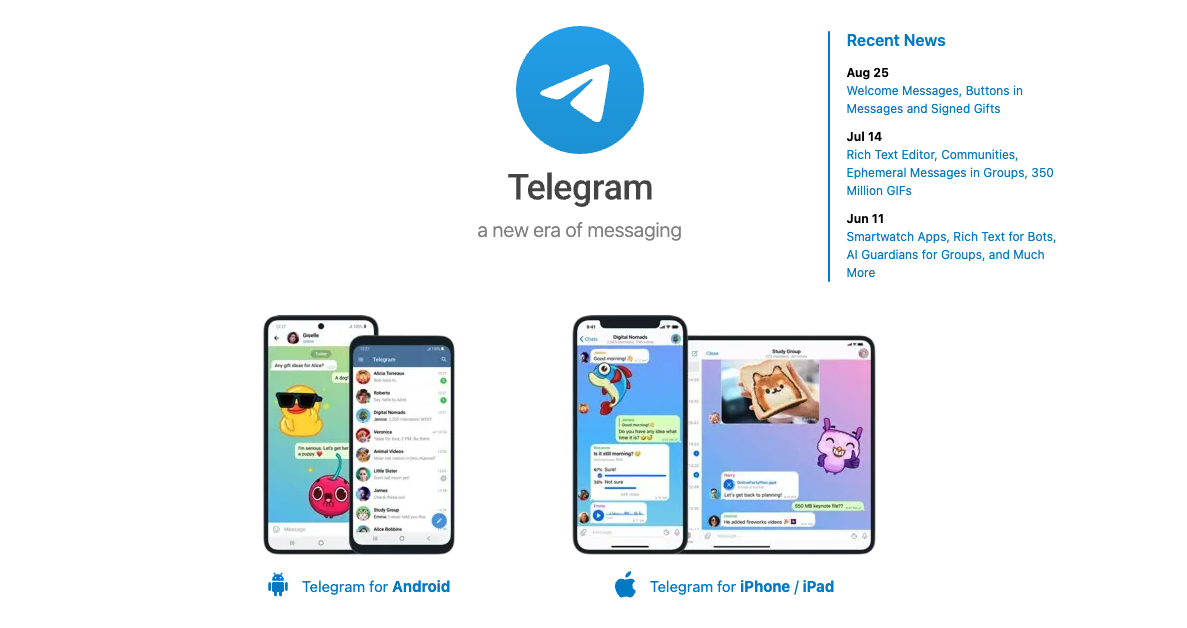
Telegram is a popular platform for heavily encrypted conversations. By default, one-on-one chats, group chats, and channels use client-server encryption, meaning messages are encrypted in transit but Telegram's servers can technically access them. For true end-to-end encryption, users need to start a secret chat, which restricts the conversation to one-on-one and prevents even Telegram from reading the content.
Secret chats are device-specific, so a conversation started on one device isn't accessible from another. They also support self-destruct timers for messages, files, photos, and videos, and can force the other participant's copy of a message to delete as well.
Telegram's client apps are open source, but its server-side code is proprietary, which limits independent verification of how the backend actually handles data.
Features
- Secret chats with true end-to-end encryption (one-on-one only)
- Messages, files, and media can self-destruct on a timer
- Distributed servers spread globally for speed
- Open-source client apps (server code is closed source)
- No practical limits on media or chat size
- Groups supporting up to 200,000 members
- Send documents of any type
Cost: Free, with an optional Premium subscription that removes ads and adds extras like custom emoji and higher upload limits. Ads may appear in public channels on the free tier.
Number of users: Telegram has over 1+ billion monthly active users.
5. Pryvate
Pryvate Messenger is a secure messaging app available for Android, iOS, and desktop that protects voice calls, video calls, instant messaging, email, and browsing. It uses RSA-4096 and AES-256 encryption, along with Post-Quantum ZRTP for calls, and operates on a freemium model rather than being fully free.
Users can delete messages for all parties, set self-destruct timers, and remotely wipe messages from a recipient's device. The app also includes built-in screenshot detection, which alerts a user in real time if someone tries to capture a conversation, along with anti-blocking technology designed to maintain access on restricted networks.
Pryvate also offers a separate business-focused version for SMEs that need centralized control over their organization's communications.
Features
- Delete for all, self-destruct messaging, and remote wipe
- Screenshot detection alerts
- Anti-blocking technology for restricted networks
- Anonymous registration
- Unlimited secure video conferencing
- Low-cost secure calling plans for off-network users
- SME/business solutions with organizational controls
Cost: Free tier available, with paid options for additional features or business use.
Number of users: Pryvate does not disclose its active user count.
6. AWS Wickr
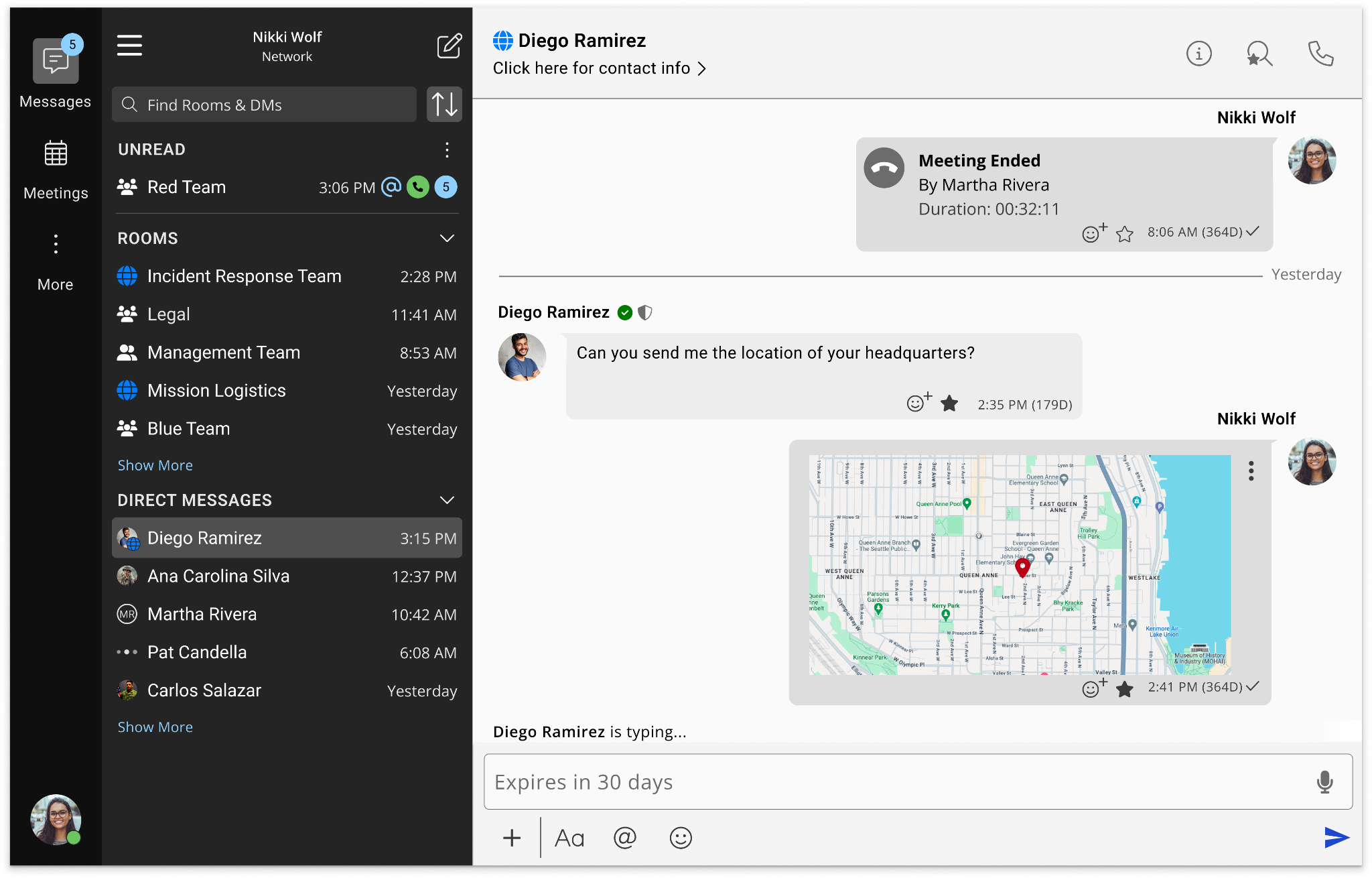
Wickr is an end-to-end encrypted collaboration platform built for organizations rather than individual consumers. Amazon acquired Wickr in 2021 and discontinued its free consumer app, Wickr Me, at the end of 2023, folding the technology entirely into two enterprise products: AWS Wickr (cloud-hosted) and Wickr Enterprise (self-hosted within a customer's own environment).
Every message, call, and file is encrypted locally on the device with a new random key each time, and Amazon states that no one, including AWS itself, can decrypt them.
Organizations get administrative controls that a consumer app wouldn't offer, like configurable data retention policies, security groups, and the ability to selectively log information to a customer-controlled store for compliance and auditing.
It's used across regulated industries like healthcare, legal, and financial services, and holds certifications including SOC 2, HIPAA, ISO 27001, and FedRAMP.
Features
- End-to-end encrypted messaging, voice, and video calls
- File and screen sharing
- Configurable, compliance-driven data retention policies
- Admin controls, security groups, and single sign-on
- Guest user access for communicating outside your organization
- Self-hosted option via Wickr Enterprise
- Available in AWS commercial and GovCloud regions
Cost:
- Free premium trial: $0 for three months
- Standard: ~$5 per user/month (varies by region)
- Premium: ~$15 per user/month (varies by region)
Number of Users: Wickr does not publicly disclose its user count. However, some organizations have shared their specific Wickr user counts, such as the U.S. Army, which has reached 100,000.
7. Rakuten Viber
Users can send voice and text messages, photos and videos to groups of any size using Viber. It also offers fully encrypted voice and video chats on mobile devices and major desktop operating systems as long as you select the correct sharing method.
The company has stepped up its game when it comes to its end-to-end encryption, as it used to be that only one-on-one communications were protected, but now group chats are also secured by E2E.
A unique feature of this app is that every chat is color-coded based on its current level of encryption:
- Green means the chat is encrypted, and the contact you are connected to is trusted.
- Grey means that the chat is encrypted, but the contact hasn't been marked as trusted.
- Red means there is a problem authenticating the contact.
Features
- HD video calls
- Chat extensions allow searching for GIFs, videos, restaurants, events, etc., through websites without ever leaving chat
- Trusted contacts verify the identities of who you're chatting with by exchanging secret keys
- Instant messaging
- Stickers
- Service messages
- Instant voice message
- Public and group chats w/ unlimited members
- Delete seen messages
Cost: Free.
Number of users: Viber has around 260 million monthly active users, making it the third biggest messaging app in the world.
8. Element
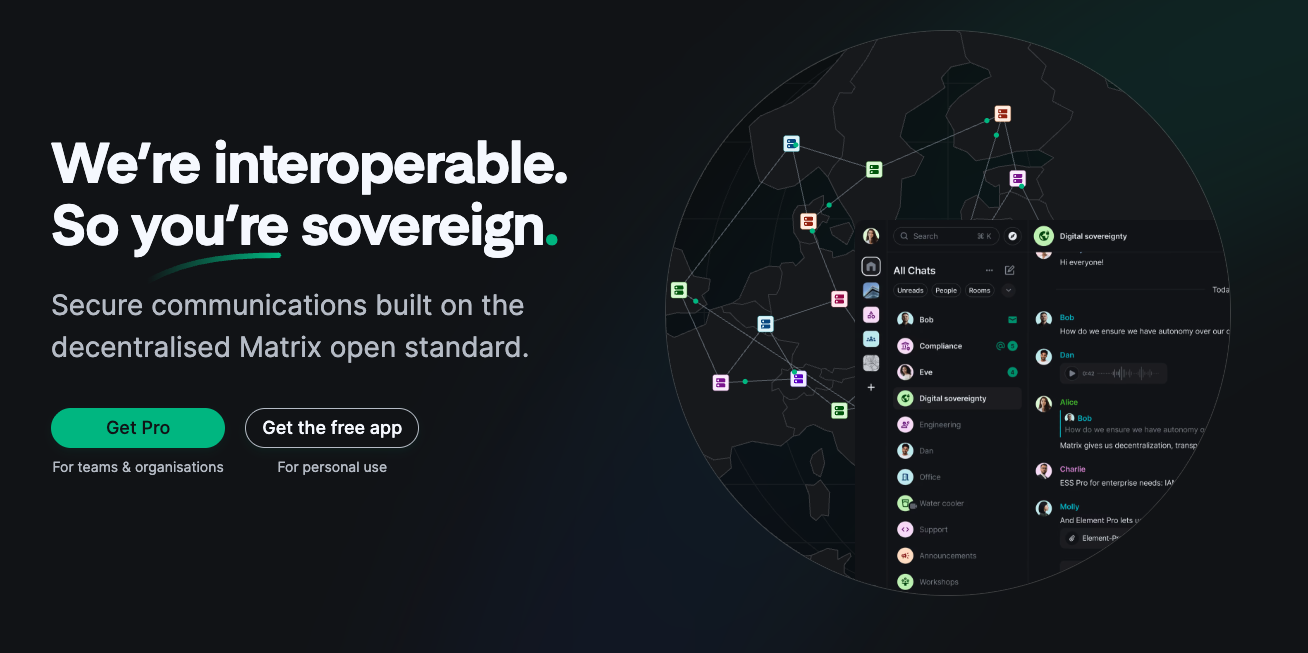
Element is a messaging and collaboration app built on Matrix, an open, decentralized communication standard.
Unlike most apps on this list, Element isn't tied to a single company's servers. Organizations can self-host their own instance or use Element's hosted service, and still communicate with users on other Matrix-based systems.
It's aimed at both individual users and organizations with strict data-control requirements, including governments and enterprises.
Features
- End-to-end encryption by default across messaging, voice, and video
- Self-hosted or Element-hosted deployment options
- Federation across separate organizations and homeservers
- Cross-signed device verification (QR code or emoji comparison)
- Threads, read receipts, polls, and file sharing
- Open source under AGPL (Community edition)
- Available on Windows, Mac, Linux, iOS, and Android
Cost: Free for individuals (Community edition, self-hosted or via the free app). Enterprise and Sovereign plans are priced per seat or per deployment, with pricing available on request.
Number of users: Element states it has 200 million-plus users worldwide across the Matrix network, but does not report on unique Element users.
9. iMessage
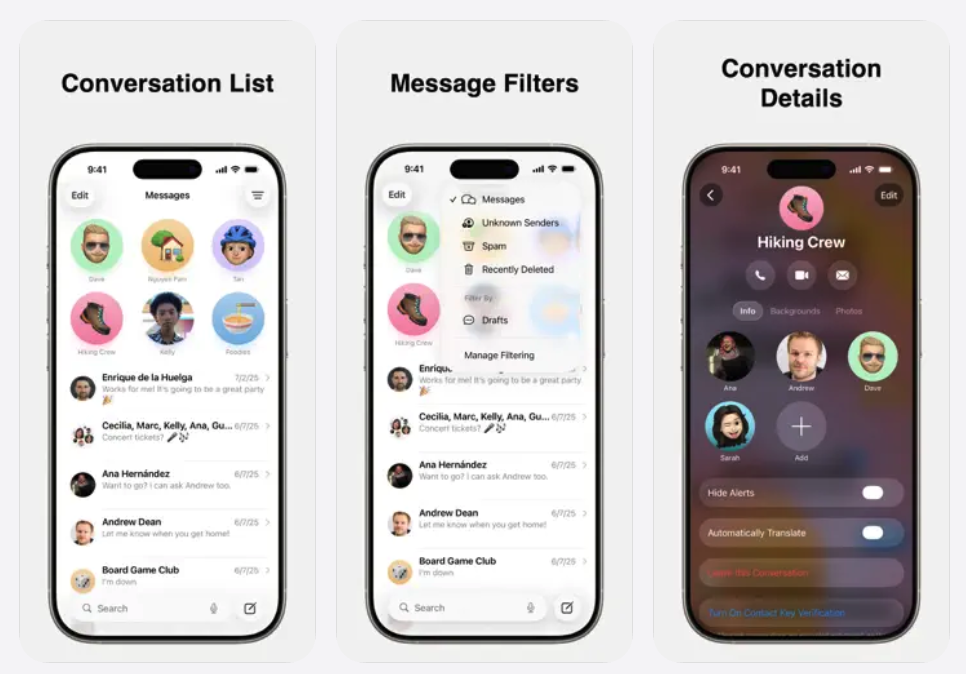
iMessage has always offered end-to-end encryption between users on Apple devices.
The main security issue users run into is with backups. By default, when iCloud Backup is turned on, Apple holds a copy of the key needed to decrypt Messages in iCloud, meaning Apple could technically access those messages if compelled to or if iCloud were breached. Apple's Advanced Data Protection setting fixes this by making iCloud backups fully end-to-end encrypted, so that not even Apple can access them. Turning it on is the more complete fix; avoiding iCloud backups entirely is no longer necessary if ADP is enabled.
Features
- Mute notifications or leave group chats
- Block phone numbers and contacts
- Backup iMessages through iCloud, with the option to fully encrypt backups via Advanced Data Protection
- Automatically delete messages after 30 days or a year via the "Keep Messages" setting
- Uses the internet instead of a phone network when communicating with other iOS or macOS users
- Control "Read Receipts"
- Customization of message profile/personality with GIFs, animations, and Memojis
Cost: Free.
Number of Users: Public sources report that iMessage has over 1.3 billion users.
10. LINE
LINE is a free messaging app available on a variety of smartphones and PC.
The platform was developed by a team of Japanese engineers as a way to communicate after the Tōhoku earthquake struck the region in 2011. The country's telecommunications infrastructure was badly damaged, so internet-connected communication became the only reliable option.
Shortly after launch, LINE added end-to-end encryption and called the feature "Letter Sealing." It was originally opt-in, but Letter Sealing is now turned on by default in major LINE clients, protecting text messages, calls, and location sharing automatically.
As of November 2024, that encryption also extends to images, voice messages, videos, and file attachments. In group chats, messages are only end-to-end encrypted if every participant in the group, which can have up to 50 members, has Letter Sealing enabled.
Features
- Letter Sealing end-to-end encryption, on by default
- Over 10,000 stickers of characters and celebrities
- Follow official accounts of favorite artists, celebrities, brands, and TV shows for news and promotions
- Share text, photos, and videos on Timeline
- Add friends with the "Shake It!" function, where both people shake their devices near each other to exchange contact information
- Live video
- OpenChat, an online space to meet new people based on shared interests (available in Japan, Thailand, and Indonesia)
Cost: Free.
Number of users: Line does not share an official total number of users, but estimates put it at over 700 million worldwide, with the greatest concentration in Japan at 89 million, followed by Thailand at 51 million.
Most Secure App?
It's fully open source, so its code can be independently inspected rather than taken on faith. It's funded by donations and grants through the nonprofit Signal Foundation, not by advertising or user data, which removes the incentive to monetize conversations.
The Signal Protocol itself has also proven influential. WhatsApp adopted it for end-to-end encryption in 2016, and Meta built Messenger's default encryption, rolled out in 2023, on the same protocol. That reach means the protocol has been scrutinized and tested at a scale few encryption schemes reach, by security researchers and cryptographers well beyond Signal's own team.
What About WhatsApp?
WhatsApp is owned by Meta, and WhatsApp remains one of the Meta Companies for privacy policy purposes. In practice, this means WhatsApp shares certain user data, such as device information, usage logs, and business interaction details, with Meta and its other products, even though message content stays end-to-end encrypted and unreadable by WhatsApp or Meta.
This arrangement has faced sustained legal pushback in India, WhatsApp's largest market. India's Competition Commission fined Meta roughly $25 million in November 2024 for abusing its dominant market position with WhatsApp's 2021 "take it or leave it" privacy policy, and ordered a five-year halt to sharing user data with other Meta companies for advertising.
That order has moved through appeals since, and as of early 2026, it's in front of India's Supreme Court, which has criticized WhatsApp's opt-out process as inadequate and signaled it could bar the advertising-related data sharing entirely.
What does this mean for you? Your WhatsApp messages themselves stay encrypted and private between you and the recipient, but metadata and account information can still flow to Meta, and regulators in at least one major market don't think users have a meaningful way to opt out of that.
Need HIPAA Compliance for Healthcare Communications?
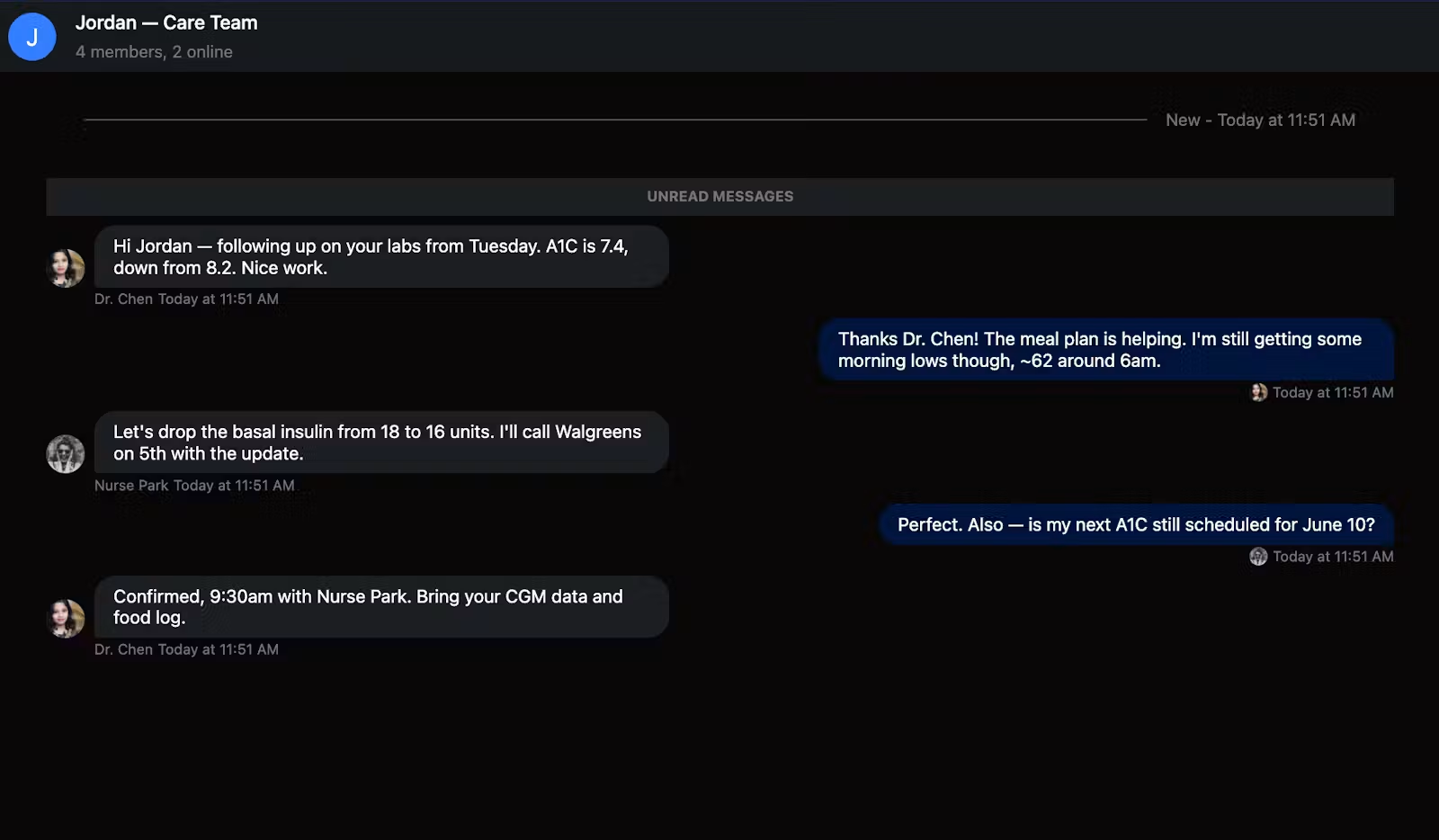
Secure, compliant communication between healthcare organizations and patients is essential, and the bar is about to rise.
The HIPAA Security Rule hasn't seen a substantial update since 2003, long before cloud computing and modern messaging apps existed. In January 2025, HHS proposed the first major overhaul since 2013, which would make encryption of patient data (both in transit and at rest) and multi-factor authentication mandatory, along with stricter breach-reporting timelines.
As of mid-2026, the rule remains proposed, with a final version not expected until late 2026 or 2027. But regulators are already enforcing in this direction, so we recommend building toward these standards now.
When evaluating a messaging platform for healthcare use, look for:
- Strong encryption for patient data, in transit and at rest
- Multi-factor authentication for anyone accessing patient data
- Detailed audit logs and access controls
- A signed Business Associate Agreement (BAA) with the vendor
Didn't Find a Good Fit? Build Your App In-House
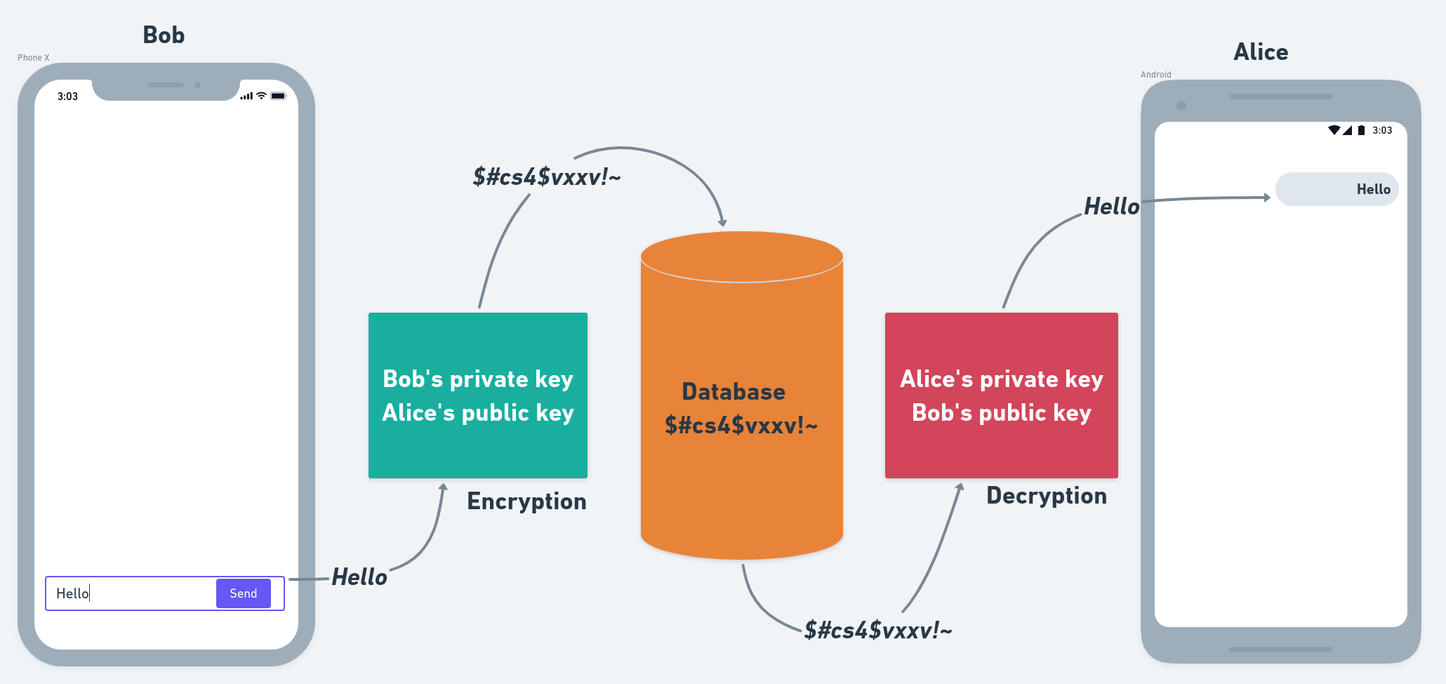
If none of the apps above fit your needs, building your own messaging platform is a realistic option. Stream's Chat API and Video API let you build a secure communication solution with the specific security controls your use case requires.
Health coaching platform Fitelo took this route after personal WhatsApp numbers led to client data being misused. The team replaced WhatsApp with in-app chat built on Stream, so coaches and clients never have to share phone numbers.
By default, Stream Chat encrypts messages in transit (TLS) and at rest (AES-256). For applications that need full end-to-end encryption, Stream's SDKs support client-side key generation and message encryption, so only the sender and recipient can read message content.
Stream Video goes further with native end-to-end encryption for calls. You can create a dedicated encrypted call type in the Stream Dashboard, and every call of that type is automatically encrypted device-to-device.
Conclusion
Headlines about security breaches appear almost daily in our connected world, making it more important than ever to stay cautious about identity and data theft.
The lack of privacy on older, well-known apps has driven the development of newer apps like the ones featured above, built with security as a core focus. Using one of these secure chat apps to talk with friends, family, and coworkers helps protect you against anyone trying to steal your data.
Each app in this list offers end-to-end encrypted messaging, cross-device syncing, and multi-mode communication (voice, text, video), but each also has its own strengths and weaknesses. The right one for you depends on which additional features matter most.