
13 Fintech APIs: Technical Breakdown for Developers


Today's fintech users have high expectations for their apps, including fast payment processing, real identity verification, and fraud protection that works without getting in the way.
The choice carries real technical weight; it's what determines where your engineers spend their time.
Rather than building this advanced functionality from the ground up, consider integrating these fintech APIs into your product.
To help you pick, we've broken down each API below by use case, strengths, implementation details, compliance posture, and pricing model.

Payment Processing APIs
Whether it's paying your friend back for dinner or purchasing an item online from your favorite e-commerce site, many users interact with payment processing platforms daily to chat with knowledgeable sellers about a specific product or to verify that their purchase is on its way to their house.
But payment processing is complex. These APIs simplify adding payment functionality to your app.
1. Stripe APIs

Use Case: The Stripe APIs are used for accepting and sending payments across web, mobile, and in-person retail, with support for recurring billing, invoicing, and multi-currency transactions.
The API surface is organized into distinct named products beyond core Payments, including Billing (subscriptions), Connect (marketplaces/platforms), Radar (fraud), Identity (verification, covered separately below), and Financial Connections (bank account linking). All share the same account, authentication, and API mechanics.
Key Strengths:
- Supports over 135 currencies for global payment acceptance.
- Built-in fraud prevention via Stripe Radar, a machine-learning risk engine.
- Prebuilt UI components reduce checkout implementation time.
Implementation Notes:
- REST API with predictable, resource-oriented URLs and JSON responses.
- Authenticates via API keys (secret keys for full access, restricted keys scoped to specific permissions).
- Full sandbox environment available; API key determines live vs. sandbox mode.
- Server-side SDKs for Node.js, Ruby, Python, Go, PHP, Java, and .NET.
- Default rate limiter caps live-mode requests per second; higher limits available on request through Stripe Support.
Compliance & Security:
- Stripe is a PCI DSS Level 1 certified service provider, the highest tier of card-data compliance.
- Offers a Data Processing Agreement (DPA) where Stripe acts as your Data Processor; it contractually commits to CCPA-specific handling rules and supports data subject access/deletion requests, and Stripe has certified participation in the EU-U.S. Data Privacy Framework for lawful cross-border data transfers.
Pricing Model: Usage-based. Percentage-plus-fixed-fee per transaction (rate varies by payment method and region); no cost to access sandbox or documentation.
2. PayPal Payments API

Use Case: The PayPal Payments API is used for authorizing, capturing, and refunding payments, and managing disputes, invoices, and subscriptions for apps already integrated with PayPal's ecosystem.
Key Strengths:
- Broad API suite covering disputes, invoicing, billing plans, subscriptions, and catalog products beyond basic payments.
- Uses a standard, well-documented OAuth 2.0 and REST structure.
Implementation Notes:
- REST API using JSON payloads and standard HTTP methods.
- Authenticates via OAuth 2.0; access tokens are obtained server-side and must never be exposed client-side.
- Full sandbox environment at a separate API host for testing before going live.
Compliance & Security:
- PayPal's own developer security guidance explicitly ties credential handling and logging practices to PCI DSS compliance obligations.
- Requires HTTPS and TLS 1.2+ for all API traffic.
Pricing Model: Usage-based, per-transaction fee structure; exact rates vary by region, payment method, and merchant agreement.
3. Braintree API

Use Case: The Braintree API is a PayPal-owned payment solution, great for end-to-end payment processing for apps needing card, wallet (Apple Pay, Google Pay, Venmo), and local payment method support in one integration.
Key Strengths:
- Single integration covers cards, major digital wallets, and Venmo (US).
- Vaulting lets you securely store customer payment methods to reduce checkout friction on repeat purchases.
Implementation Notes:
- Client SDKs (JavaScript, iOS, Android) paired with server SDKs; authorization typically via a client token.
- Sandbox environment available for testing with test card numbers before production.
- Documentation has moved from a standalone Braintree domain to PayPal's own developer portal (developer.paypal.com/braintree) as the two products integrate more closely.
Compliance & Security:
- Braintree is a validated Level 1 PCI DSS compliant service provider.
- Offers ready-built payment interfaces (Drop-in UI, Hosted Fields) that qualify for the simpler SAQ-A PCI validation path, reducing merchants' own compliance scope.
Pricing Model: Usage-based, per-transaction fee structure; specific rates depend on payment method and merchant agreement.
4. FedNow API
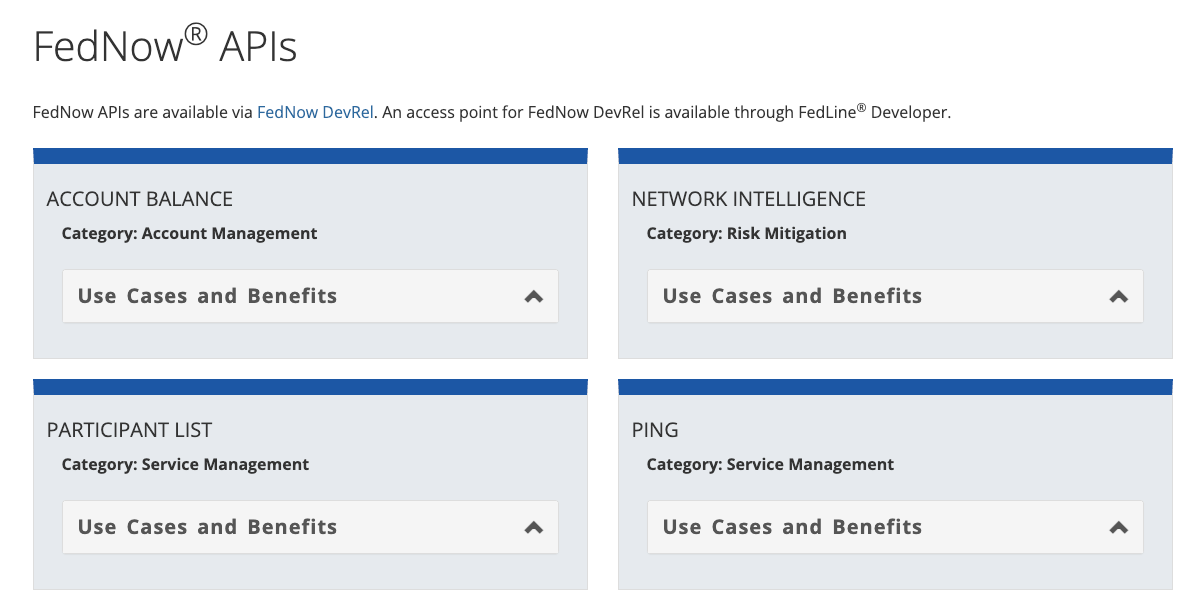
Use Case: The FedNow API offers instant, 24/7/365 settlement of payments between US bank accounts. It works well for payroll, disbursements, or any flow where waiting 1-3 days for ACH settlement isn't acceptable.
Key Strengths:
- Backed directly by the Federal Reserve, not a private payment network.
- Settles in seconds rather than days, with no cutoff times, weekends, or holidays.
- The Fed continues to expand the service; a Network Intelligence API for real-time fraud/risk signals launched in April 2026.
Implementation Notes:
- Not a simple public sign-up: applications access FedNow through a sponsor bank or a middleware provider (e.g., Modern Treasury, Finzly, Cross River), which expose their own developer-facing API on top of the underlying rail.
- Uses the ISO 20022 messaging standard for payment data.
- The network transaction limit for customer credit transfers was raised to $10 million effective November 2025, bringing it in line with The Clearing House's competing RTP network.
Compliance & Security:
- Operated directly by the Federal Reserve Banks; access is limited to FedLine-connected financial institutions and their approved partners.
- Specific compliance requirements (BSA/AML, etc.) are set by the sponsor bank facilitating access, not uniformly published by the Fed itself.
Pricing Model: Not publicly documented as a flat fee. Pricing depends entirely on the sponsor bank or middleware provider's own commercial terms.
Banking Integration & ID Verification APIs
Integrating banking and account information into an app helps create a strong user experience. These integration and identity verification APIs ensure that linking accounts is both simple and secure.
5. Syncfy Connect API

Use Case: With the Syncfy Connect API, you can aggregate a user's full financial picture (bank accounts, credit cards, and crypto exchange balances) for lending, budgeting, or account-linking features, particularly across Latin America.
Key Strengths:
- Covers 125+ financial institutions and service providers across 15+ countries in Latin America and beyond.
- Extends beyond account aggregation into e-invoicing and tax authority integration - useful for markets with electronic invoicing mandates (e.g., Mexico's CFDI system).
Implementation Notes:
- REST API with a white-labeled connection widget for linking end-user accounts.
- Additional dedicated APIs for invoicing and payment acceptance beyond core aggregation.
Compliance & Security: Not publicly documented; Syncfy does not publish specific compliance certifications (e.g., SOC 2) on its public-facing materials as of this writing.
Pricing Model: Not publicly documented; Syncfy's pricing requires contacting the company directly.
6. ID.me API

Use Case: The ID.me API is used for verifying that a new user is who they claim to be, including document authenticity checks and military/government affiliation verification.
Key Strengths:
- Verification methodology is built on NIST 800-63-3, a US federal identity assurance standard.
- Includes SCRA (Servicemembers Civil Relief Act) monitoring specifically for servicing military accounts.
- Actively expanding into regulated sectors; FINRA began requiring ID.me verification on its Entitlement Platform in 2026.
Implementation Notes:
- Offers SDKs and a developer portal supporting OAuth 2.0 / OpenID Connect and SAML integration.
- Provides prebuilt integration options (e.g., a Shopify app) alongside direct API/SDK access.
Compliance & Security:
- Holds what ID.me calls its "Triple Crown" of security certifications: SOC 2 Type II, ISO/IEC 27001:2013, and FedRAMP Moderate Authorization to Operate.
- Encrypts personally identifiable information using FIPS 140-2 approved AES-256 encryption with dynamic key rotation; hosted within a FedRAMP-authorized AWS environment.
- Follows NIST 800-63-3 identity assurance guidelines, the standard used by US federal agencies for identity verification.
Pricing Model: Not publicly documented; requires contacting ID.me directly for pricing.
7. Stripe Identity: Verification Sessions API

Use Case: Stripe's Verification Sessions API verifies a user's government-issued ID (with an optional selfie check) or confirms name, date of birth, and national ID number against official records. It's great for onboarding flows that require KYC-style identity checks.
Key Strengths:
- A single session object tracks the entire verification lifecycle, from creation through completion, simplifying state management on your backend.
- Failed checks return a specific machine-readable error code (e.g.,
document_expired), so you can handle common failures programmatically rather than showing a generic error.
Implementation Notes:
- Create a VerificationSession server-side, specifying a check type (
documentorid_number); pass the session's client secret to the frontend to complete verification. - Sessions emit webhook events for each status change (created, processing, verified, requires_input, canceled, redacted).
- Idempotency keys are recommended when creating sessions to avoid duplicate verification attempts for the same person.
Compliance & Security:
- Supports redaction on request: personally identifiable information can be permanently redacted from a session, its associated verification report, and related events. This is relevant for GDPR/CCPA-style data deletion requests. Redaction can take up to 4 days to complete.
- The client secret used to complete verification is explicitly documented as sensitive and must never be logged, embedded in URLs, or exposed beyond the user being verified.
Pricing Model: Usage-based, billed monthly in arrears based on the prior month's usage; cost varies by verification type and your account's billing location, not the verified user's. No charge for abandoned sessions - billing only starts once a verification completes.
8. Plaid API

Use Case: The Plaid API links a user's external bank accounts to your app for account opening, balance checks, transaction history, and investment/retirement account aggregation.
Key Strengths:
- Investments API specifically aggregates brokerage, retirement, and investment accounts for a holistic financial view.
- Rate limits are structured per-Item and per-client, so a spike from one user's linked account won't exhaust your entire app's quota.
Implementation Notes:
- Three distinct environments: Sandbox (fake data, unlimited), Development, and Production.
- Linking flow uses a client-server handshake: create a
link_tokenserver-side, complete Plaid Link client-side, exchange the resultingpublic_tokenfor a longer-livedaccess_token. - Official documentation publishes exact per-minute rate limits for specific endpoints (e.g.,
/transactions/get,/accounts/get), separately for Sandbox and Production. - Supports both OAuth-based bank authentication and, where required, alternative multi-factor flows (OTP, KBA).
Compliance & Security:
- Certified under ISO 27001 (information security) and ISO 27701 (privacy information management), and SOC 2 (SSAE18) compliant.
- Encrypts data using AES-256 and TLS; provides its own multi-factor authentication as a backup when a linked institution doesn't offer one.
- Publishes a dedicated security portal (security.plaid.com) where SOC 2 reports, ISO certificates, and penetration testing results are available on request.
Pricing Model: Usage-based, billed per linked account or per API call depending on the product (e.g., Auth, Transactions, Identity, Investments each have distinct fee structures); a free Sandbox and limited free Development tier are available before production billing begins.
9. Marqeta

Use Case: Marqeta provides card issuing and Banking-as-a-Service infrastructure, letting a company create and manage virtual or physical debit, prepaid, or credit cards programmatically without building banking infrastructure from scratch.
Key Strengths:
- Just-in-Time (JIT) Funding lets you approve and fund transactions in real time, rather than pre-loading balances.
- Real-time transaction decisioning and fraud controls are built into the core platform, not a separate add-on.
- Used in production by major platforms, including Square and Klarna.
Implementation Notes:
- Open APIs and webhooks; a public sandbox is available to start testing in a few clicks, no sales call required to begin.
- Supports multiple card types (debit, prepaid, credit, virtual, tokenized) and funding models (JIT, prefunded, pooled balance) configurable per program.
- Program launch still typically involves Marqeta's own program management team for compliance and issuing-bank partnership setup, even though initial API testing is self-service.
Compliance & Security:
- PCI DSS Level 1 certified, and maintains SOC 1 and SOC 2 (SSAE-18) Trust Services certifications covering Security, Availability, and Confidentiality.
- Requires TLS 1.2+ for all platform communication; uses bank-grade encryption for PII, PCI, and PIN data both in transit and at rest, and tokenizes card numbers rather than storing them directly.
Pricing Model: Not published publicly; contact Marqeta's sales team for pricing.
Fraud Detection & Risk Monitoring
Verifying who someone is at signup only solves half the problem.
These APIs cover the rest: scoring transactions, flagging suspicious behavior across a customer's entire lifecycle, and catching fraud attempted through conversation rather than through a payment or application.
10. Sardine

Use Case: Sardine monitors fraud and AML risk across a customer's full lifecycle, from onboarding (KYC/KYB, document verification, synthetic identity detection) through ongoing device and behavioral biometrics to real-time scoring of individual payment and crypto transactions.
Key Strengths:
- Covers onboarding risk and ongoing transaction monitoring in one platform, rather than requiring separate tools for each.
- Its Sonar consortium shares fraud intelligence across customers, so a confirmed fraud pattern at one company can help flag the same behavior elsewhere in the network.
- Purpose-built device and behavioral biometric SDKs for web, iOS, and Android feed directly into its risk scoring.
Implementation Notes:
- Separate APIs for onboarding signals, device/behavioral intelligence, and transaction fraud scoring.
- API documentation and integration guides require booking a demo first, rather than instant self-service signup.
Compliance & Security:
- SOC 2 Type II certified and GDPR compliant.
- PCI DSS compliant for handling payment card information.
Pricing Model: Not published publicly; requires contacting Sardine directly to scope pricing based on volume and use case.
11. Unit21

Use Case: Unit21 is a no-code fraud and AML platform for transaction monitoring, case management, and identity verification, built so risk and compliance teams can write and adjust detection rules themselves without waiting on engineering.
Key Strengths:
- No-code rule editor lets risk teams build and adjust fraud/AML rules directly, without engineering involvement.
- Graph Analysis visualizes hidden connections between devices, IPs, and wallets to expose organized fraud rings.
- Backed by the founders of Plaid and Chime.
Implementation Notes:
- Combines an API with a no-code rules dashboard for ingesting and acting on transaction and customer data.
- A "Testing Mode" (shadow, validation, and sandbox) lets you run new rules against historical and live data before deploying them, to gauge impact on false positives before going live.
Compliance & Security:
- SOC 2 Type I and Type II certified, audited by Armanino.
- Undergoes regular third-party penetration testing, conducted by Doyensec and Cobalt.
Pricing Model: Not published publicly; pricing is customized based on factors like business size and volume.
12. Socure

Use Case: Socure verifies a user's identity and predicts fraud risk across the digital customer lifecycle, aiming to reduce both fraud losses and false declines of legitimate customers during onboarding and beyond.
Key Strengths:
- A genuine self-service developer portal. You can access REST API docs, SDKs, and quick-start guides directly, without booking a demo first.
- Bank account ownership verification matches provided account details against Socure's own data sources in real time.
- Webhooks provide real-time and event-driven identity updates rather than requiring polling.
Implementation Notes:
- REST APIs with API key authentication; a "Hello World" quick-start guide walks through building an ID verification flow from scratch.
- Socure ID+ modules can be integrated individually depending on which verification/fraud signals you need.
Compliance & Security: Holds three ISO/IEC 27000-series certifications covering the privacy, confidentiality, and security controls of its ID verification service.
Pricing Model: Not published publicly; requires contacting Socure to learn pricing.
13. Stream Moderation API

Use Case:
Stream's Moderation API provides real-time content moderation across text, image, and video, including a rule category specifically labeled SCAM. You also get harassment and toxicity detection, a complementary layer to the transaction- and identity-focused tools above, that catches fraud attempts through conversation (social engineering, romance scams, payment solicitation messages) rather than through a payment or account application.
Key Strengths:
- The moderation check endpoint returns a direct, actionable recommendation (
keep,flag, orremove) rather than just a raw risk score you have to interpret yourself. - Severity-tiered rules (e.g., low/medium/high/critical for a given label) let you flag borderline content for review while auto-removing clear violations.
- Easily integrates with Stream's own Chat, Feeds, and Video SDKs.
Implementation Notes:
- A single
moderation.check()call handles text, image, and video content against a configurable rule set you define viaupsertConfig. - Webhooks notify your system when flagged content needs review, and a moderation dashboard is available out of the box for manual review workflows.
Compliance & Security: Stream holds SOC 2 Type II and ISO 27001:2013 certification, alongside existing HIPAA and GDPR compliance.
Pricing Model: Tiered plans from free to Enterprise, with custom pricing available by contacting Stream directly. Higher tiers add advanced features such as an NLP engine, facial recognition, and OCR.
Final Thoughts

As conversational banking, stock trading, lending, peer-to-peer payments, and micro-investing continue to grow, the market for fintech apps and platforms will only accelerate.
The most popular fintech apps (think: Venmo, PayPal, Robinhood, and more) already rely on API integrations to deliver nuanced features without burdening their engineers.
When adding datasets, security frameworks, and even in-app communication such as chat and activity feeds, use this list as your starting point. We recommend always referencing each API's most up-to-date documentation, as pricing, features, and even product names can change.