
How to Evaluate Sovereign AI: 7 Steps for Product Teams


TL;DR
- In this post, sovereign AI means your team controls the compute, data, and model behind a product and can replace any of them without a vendor’s consent.
- Hosting location is the easiest thing to check and the least complete test.
- Few teams can own every layer. Teams choose which of compute, data, and model must be sovereign and accept foreign providers for the rest.
- Downloadable weights come with license terms. Apache 2.0 permits modification, redistribution, and commercial use, while other licenses can limit scale or commercial use. Teams should read the license before building.
If you build a product on AI, someone (a customer, a regulator, or your own legal team) will eventually ask whether it is sovereign.
Some teams answer by naming the region where their data is hosted. But, sovereignty also depends on who controls the compute, where the data lives, which model you run, and how quickly you can replace any of them. If one of these lives with a vendor you can’t replace, your product can stop working when that vendor changes its price, its terms, or its availability.
This post shows how to test for that. It covers the most common evaluation mistakes, what to check at the compute, model and data layers, the hosting options, and a 7-step process to run before you call your architecture sovereign.
Evaluating Sovereign AI Projects: Mistakes Developers Make
A sovereign AI project can fail when the team tests the wrong things. These are the mistakes I see most often:
- Never defining what “sovereign” means
- Trying to own every layer of Sovereign AI
- Treating data location as proof of control
- Assuming downloadable weights have unlimited rights
- Benchmarking open-weight capabilities against frontier closed models
- Skipping the cutoff and switching tests
What is Sovereign AI and Why is It Needed?
Sovereignty allows organizations and teams to build, run, modify, and govern AI domestically, without relying solely on foreign firms' closed APIs or licensing terms. Sovereignty provides control over each component of an AI stack rather than eliminating dependencies.
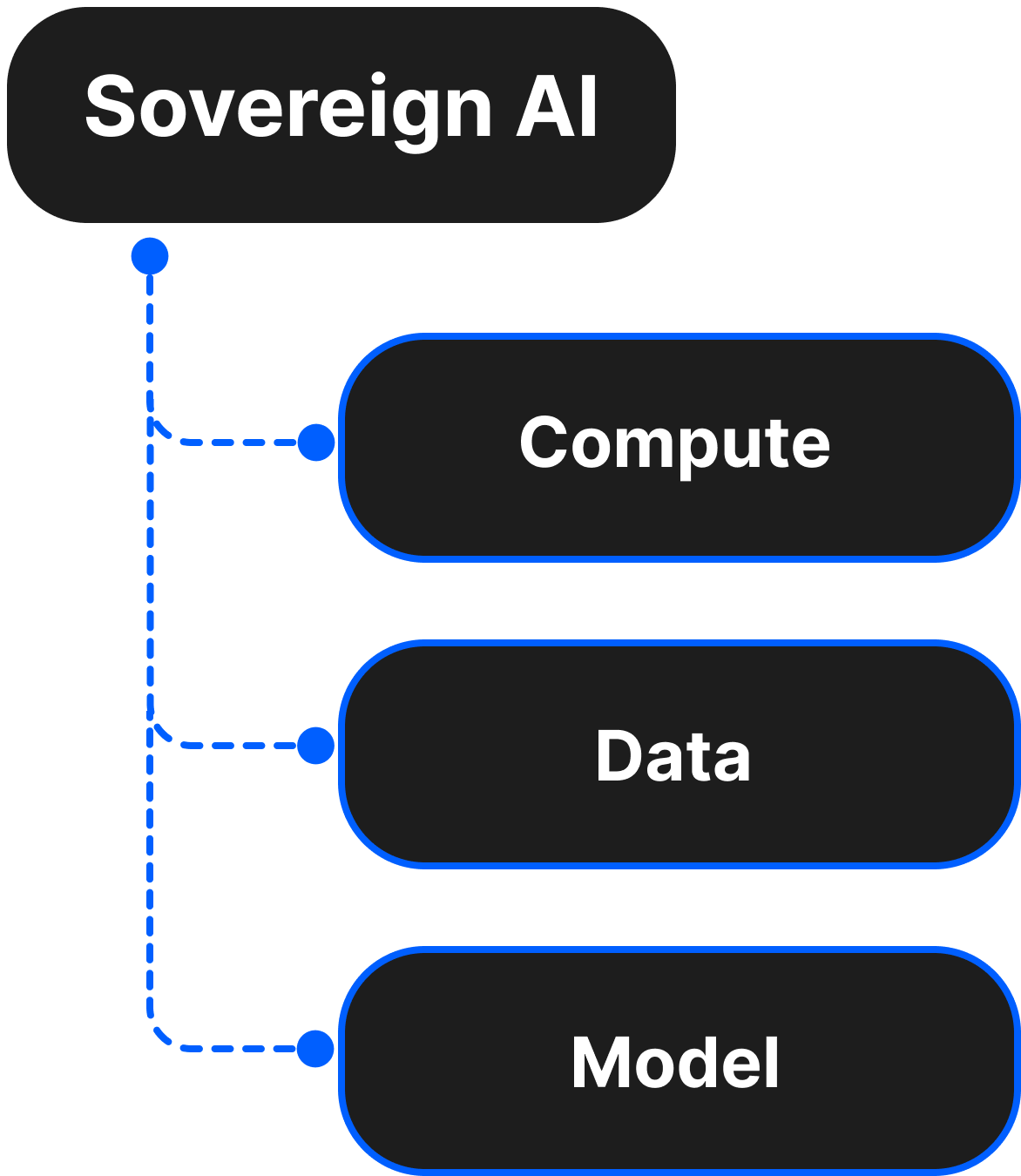
There is no official definition of sovereign AI, and its drivers (cultural, regulation, autonomy, etc.) vary widely. However, it relies on three main layers: compute, data, and model.
To make a solution or an AI stack sovereign, teams need to choose which layers of the stack (compute, data, model) matter most and accept reliance on foreign providers for the rest. For some teams, the concern may be to prevent a security leak (IP), protecting sensitive data, and ensuring access to advanced AI capabilities. Organizations and larger teams, on the other hand, may want to leverage greater computing power for local AI and fine-tuning lightweight models.
- Compute: Building AI infrastructures such as CPU clusters, inference hosting, supercomputers, and national data centers.
- Data: Data hubs and datasets platforms such as Kaggle and Hugging Face.
- Model: Efforts to own models or customize and fine-tune open-weight ones.
Achieving full sovereign AI is complex and often not feasible, so focus on a specific part of the AI stack you want to make sovereign and use trusted partnerships for the rest. For instance, an enterprise or large organization can build its own data center and AI models to achieve AI sovereignty. On the other hand, developers working in small businesses can rely on open-weight models and fine-tune them on open-source datasets for sovereignty without requiring their own hardware for computation or data center.
Define What Sovereign Means for Your Team Before Choosing a Stack
Developers will often use a locally hosted or cloud-based model and then notice its tracing service links back to external third-party providers. For instance, you may want to use a faster, general-purpose AI assistant like Mistral Vibe, with your definition of sovereignty being an EU-hosted server.
However, not everyone realizes that it is powered by a US-based AI company, Cerebras, making it even faster than ChatGPT. Using a service like this may be subject to US legal reach, such as the CLOUD Act. This will allow federal law enforcement to subpoena a U.S.-based technology company to provide data stored on its servers.
Most engineering teams begin a sovereign AI project with the aim of achieving it completely at all layers. In reality, you could spend months or even years with a huge budget, which isn’t wholly attainable. Any of the layers discussed in the previous section can be used to achieve some form of sovereignty. A government agency or a district (with talent and unlimited resources) can use all three levels as a checklist for AI sovereignty. If location and data residency are what matter for your AI stack, you could, for example, choose only American AI providers for infrastructure and models.

If the model part is the only layer you would like to make sovereign, you could consider using fully open-source AI infrastructure, Qwen models, Mistral Large 4, Reflection’s Beam, Kimi K3, or Muse Spark Open with complete commercial and customization freedom.
How Should You Evaluate AI Compute for Sovereignty?
Considering the compute layer of sovereign AI, the US and China provide about 90% of the compute behind frontier AI. NVIDIA alone supplies GPUs for about 45% of infrastructure projects, according to CNAS’ report above. The compute layer should be evaluated based on control, access, and the foreign technologies your company is willing to use.
- Jurisdiction and Operator. Where is the underlying infrastructure located, who runs it, and whether outputs stay inside the legal boundaries you care about.
- Who Has Ownership and Controls Access?: Investigate who can revoke, reprice, reprioritize, or limit the capacity of your stack’s compute.
- Trace dependencies across chips, servers, networking, and cloud software. For each supplier, identify a replacement and estimate how long a switch would take.
- How Much Capacity is Needed?: Measure whether it can sustain the inference workload at an affordable cost.
- Cutoff Test: Check whether you can keep the service running locally and recover if a failure occurs or vendor support becomes unavailable.
How Should You Evaluate an LLM for Sovereignty?
There is no definitive guide to evaluating the sovereignty of an AI model. An LLM’s sovereignty can mean different things across use cases.
For non-US projects, the objective may be to seek alternatives to American AI dominance while expecting high capabilities at lower cost. Additionally, some EU and US companies have concerns about security and IP sharing and feel reluctant to use Chinese models.
If IP and security are the issues that concern your team the most, consider experimenting with sovereign AI models from these American and European technology labs.
| Company | Open Weight Model | Description |
|---|---|---|
| Reflection | Beam | A 501B open-weight model built for coding, reasoning, and agentic workloads. |
| Aleph Alpha | Kolibri | A specialized sovereign large language model for mission-critical environments. |
| Mistral | Mistral Large 4 | For organizations that need sovereign and auditable AI for security operations. |
| Meta AI | Muse Spark Open | An open-weight model giving developers control over how and where they choose to build. |
| Google DeepMind | Gemma 4 | A family of generative artificial intelligence models. |
Evaluating an LLM for sovereignty should begin with assessing your use case and asking some questions about a model’s role in the project.
- Can It Run Independently? Verify that your team can obtain detailed information about the model’s weights.
- What Does the License Permit? Check the terms of the model version. Can it be fine-tuned, redistributed, or used commercially?
- Can It Be Used Locally at a Sustainable Cost? Use your local AI stack to test it on real tasks in relevant languages and dialects.
- Can Its Behavior Be Changed or Replaced? Can your team change the model’s behavior in the event of an incorrect refusal?
How Should You Evaluate Data for Sovereignty?
Data is the most overlooked layer of sovereign AI, despite being important for national identity and security. When building AI projects for healthcare, legal, and finance, documents, files, and data privacy are paramount.
For these sectors, the key drivers of sovereignty include keeping sensitive data at home, adhering to culture (language and norms), and ensuring economic use. There are different ways to evaluate data for sovereignty in an AI stack.
- Residency and Privacy Control. Always examine where the corpus is located, who can control access, and whether training, fine-tuning, and inference keep users’ data inside the jurisdiction. An AI platform that allows data to traverse foreign networks or be stored on foreign servers during training and inference is not worth using for a sovereign project. Sovereign data governance requires no data (IP) leakage to foreign soil and commercial entities. It must be domestically hosted on private clouds.
- National Data Access and Maintenance: Always investigate whether your country/state maintains secure, standardized data repositories and sharing frameworks that are accessible to domestic developers and researchers. Without regularly maintained, publicly available datasets and secure data-sharing infrastructure, domestic organizations will still rely on foreign data sources to build domain-specific AI services.
- Who Has Authority Over Its Use?: Scrutinize your AI stack to determine data-sharing and reuse policies.
- How Does Your Data Move?: Trace training records, user prompts, logs, and backups through the system. Verify who can read each copy and who controls the encryption keys.
- Can You Enforce Decisions or Switch Providers?: Test whether you can enforce retention rules and move data to another provider.
How Do You Measure Sovereignty in an AI Stack?
A sovereign AI stack can have all the compute it needs, while developers still struggle to explain failures, switch models, or serve requests affordably. I’d judge sovereign AI by what my team can inspect, modify, and keep running at a lower cost.
Transparency: Can You See What You’re Running?
This is one of the easiest metrics to collect. However, it's also one that can make sovereignty fail. Transparency should be measured across all layers of sovereign AI.
- Compute: Is the training compute disclosed?
- Data: Is the token count disclosed?
- Model: Is the base disclosed, are the weights published, and under what license?
Auditability: Can You Verify What You Are Running?
You should measure auditability independently, either on your own hardware or using your preferred method, by asking the following questions.
- Can you run a full eval suite on your own hardware locally/offline?
- Are model versions pinned and weight checksums verifiable?
- Do inference logs, prompts, and outputs live on the hardware/infrastructure you control?
- Does the layer have an independent evaluator with published results?
Flexibility: How Hard Is It To Switch AI Services?
This is one of the most important engineering questions you could ask before adopting a technology for a sovereign project. You can have GPUs, data, and the weights, and still be locked in to a technology. With models, for instance, if your project is optimized for one model’s prompt format and tool-calling, switching to another will be demanding and time-consuming. I recommend designing your stack so you can replace any component without rebuilding the rest.
- What engineering hours are required to swap a base model?
- Can you see all the vendors and third-party services your stack runs on?
- Does the license allow customization and fine-tuning? (Aim for Apache 2.0 for control and redistribution).
How Do People Host Sovereign AI Projects?
Buying a rack of Mac Minis, Mac Studios, or GPUs does not make an AI project sovereign. For sovereignty to be achieved, it must be hosted on domestic infrastructure you can control. Here are some practical hosting arrangements for any sovereign AI project.
- National Computing Facility: Startups, research groups, and businesses can rely on domestic AI factories for computing infrastructure and services that facilitate adoption. These AI factories help fund infrastructure that small companies and startups (like health and biotech projects) cannot afford.
- GPU and Cloud Capacity Rental: Use AI compute platforms such as Modal and the IndiaAI Compute Portal for sovereign hosting at affordable rates. Teams can buy computing services from providers for domestic sovereign AI hosting.
- Global Cloud Provider: Your engineering team can use a domestic service like Oracle Cloud in the Abu Dhabi Region, which offers AI compute at scale with a Supercluster powered by NVIDIA Blackwell GPUs. With this hosting, a foreign cloud company provides computing capacity within your country or in locations aligned with regional sovereignty requirements. It is a quick approach to have some Blackwells running without saving for years to buy one.
- Fully Disconnected Environment: If isolation and privacy are your key sovereign requirements, you can commit to local hosting for experimentation.
- Sovereign Private Cloud: If you want to be responsible for all hosting operations, you can host models on infrastructure you control, like Microsoft’s Private Cloud, which supports running AI models within customer-managed environments.
- Hybrid Hosting: This combines local infrastructure and cloud services, allowing you to keep and process sensitive data locally for inference, while running other workloads in the cloud.
Stop Comparing Local Models To Closed Ones
When it comes to the model layer of sovereign AI, most developers normally benchmark the capabilities of local models with frontier closed models. Developers I respect underestimate or dismiss local models because they trail behind the frontier. They also keep asking the wrong questions, such as "Are local models ready for production, or are they as good as the frontier?"
Instead, they should exercise the ability to run, modify, and govern these models domestically/offline without dependence on a closed firm’s API or licensing terms.
| Capability | Local Models | Closed APIs / Models |
|---|---|---|
| Fine-tune | ✓ | ✗ |
| Inspect / modify | ✓ | ✗ |
| Works offline | ✓ | ✗ |
| No expiry | ✓ | ✗ |
Aside from the above, I sometimes see some developers comparing, for example, a local Qwen model to Claude and concluding that local AI sovereignty is weak. This is wrong because about 85 percent of the tasks you will use an LLM for, do not require frontier intelligence. Claude models, for example, don’t provide the privacy, stability, speed, freedom, and reliability that local models do, as highlighted below.
- Sovereignty and Stability: You control which version of the model you want to use, as well as future versions.
- Offline Makes It Private: Using a local Ollama model, for instance, ensures that data never leaves your hardware.
- No Subscription: There is no cost after obtaining hardware to run a local model.
- Freedom: There are no license restrictions for local models.
- Latency: There is network latency when running AI locally.
Another obvious realization is that a few large businesses have the computation, data, talent, and capital to build their own frontier models. So engineering teams should consider using fine-tuned and quantized local models to ensure sovereignty and support specific use cases.
Don’t Treat Open-Weight as Open-Source
Open-weight models have several use cases and contribute a lot to AI sovereignty. They can be fine-tuned on local datasets for national languages, cultural context, and domain-specific use cases at a fraction of the cost of closed models. However, many developers do not check the licensing details and assume they are fully open source, only to later realize there are restrictions when scaling.
| Component | Open Source | Open Weights |
|---|---|---|
| Weights | ✓ Yes | ✓ Yes |
| Data | ✓ Yes | ✗ No |
| Source Code | ✓ Yes | ✗ No |
Practically, downloading a model’s weights doesn’t guarantee independence without checking its licensing on GitHub or Hugging Face to confirm it's under Apache 2.0, which allows developers to modify, redistribute, fine-tune, scale, and use it commercially.
License Comparison
| Criterion | Apache 2.0 | Muse Spark Open License | Research Only |
|---|---|---|---|
| Fine-tune | ✓ | ✓ | ✓ |
| Modify | ✓ | ✓ | ✓ |
| Use Commercially | ✓ | ✓ | ✗ |
| Redistribute | ✓ | ✓ | ✗ |
| Extend | ✓ | ✗ | ✗ |
Open-weight models like Meta Llama have some restrictions for commercial use and scaling limits. You should always check out the licensing before using any of the Llama models for your business or selling products built with them.
Having used open models for some time now, I have realized Gemma 4 has the most permissive license (Apache 2.0). However, you should be aware that the various versions of the Gemma models may have different licensing terms.
The 7-Step Process To Evaluate Sovereign AI
Either a neocloud inference-serving platform or a server in your country is a useful starting point. It should not be the finishing point for evaluating sovereign AI.
I would judge sovereignty by the decisions my team can make about where data goes, who gets access, which models run, and what happens when supplies are cut off. These questions can’t be answered by a location/region data selector, but an engineering exercise can.
Here’s the 7-step process your team could use:
- Define What Must Be Sovereign: Before choosing hardware or downloading open-weight models, write down your sovereign requirements.
- Evaluate Compute: Check capacity, who can reprice, limit, or revoke access.
- Data Flow and Metrics: Check training records, user prompts, inference logs, backups, and other relevant assets to know who can see what you are running.
- Don’t Judge Models By Leaderboards: For model versions, check whether you can retain the weights, run inference independently, fine-tune, and redistribute what your sovereign requires.
- Read the License: Don’t mistake open-weight models for being fully open-source. Downloading the weights alone won’t make your stack independent, but the Apache 2.0 license will.
- Build an Eval Set From Practical Tasks: Define acceptable quality for your sovereign project before comparing model candidates or relying on general benchmarks.
- Test Flexibility and Switching: Test how hard it is to switch. You can get desired GPUs, data, and weights and still feel locked in with your current AI stack.