


You're working in a warehouse when you see an automated forklift barreling towards a coworker. You whip out your phone and type "STOP!" into the app controlling the vehicle. You add another exclamation point to make sure it knows it's an emergency.
That's not good enough, and it's not how things have to be.
AI can revolutionize real-world workplaces, but not the way it works right now. There can be no typing when your hands are full, and there can be no "Thinking..." when milliseconds mean safety. To work alongside humans, any real-world AI needs to see, hear, and perceive the world as a human does. It needs to hear a shouted "STOP!" and do so, or see the forklift out of control and immediately shut it down without human intervention.
Vision and speech AI gives machines the ability to see and hear in ways that actually connect to human behavior. These systems can interact with the world in the natural way we do, integrating directly into real-world workflows.
How is this happening today? And how can developers start to think about and build AI out in the real world?
Vision AI Keeps Industrial Workers Safe
Construction and industrial environments are some of the hardest places to deploy AI. You have people and machinery constantly moving, in poorly lit environments, where a single missed hazard can result in injury and death.
Human behavior, machine behavior, and environmental state are all part of the perceptual mix, and decisions need to be made on-site, under strict latency requirements.
Kajima, one of Japan's largest construction firms, deployed Archetype's physical AI across active job sites to monitor high-risk human-machine interactions in real time. Unlike single-model or single-sensor systems, Kajima's deployment fused video, depth, LiDAR, and environmental data into a unified spatial model of the site.

This enabled the system to track:
-
Worker proximity to heavy machinery (cranes, excavators, autonomous vehicles)
-
Unauthorized entry into hazardous or exclusion zones
-
Unsafe behavioral patterns, such as workers standing in blind spots
-
Equipment anomalies (unexpected motion, machinery operating out of sequence)
Because construction sites have unreliable connectivity and high privacy requirements, Kajima ran the perception models entirely on-site, on local GPUs. This eliminated cloud latency and ensured that when the vision AI recognized a dangerous event, such as a worker stepping into a moving excavator's turning radius, it could trigger an instant local alert, a signal to the machine operator, or an automatic stop condition if integrated with control systems.
This highlights core architectural patterns developers need to adopt for industrial perception:
-
Multimodal fusion is mandatory. Text alone doesn't work. You need video and audio at a minimum to start to understand these environments. Depth, LiDAR, and sensor telemetry then help to stabilize the model of the world and reduce failure modes.
-
Edge inference is the default. If your model's output is tied to safety or machine control, you cannot afford cloud round-trips. Latency budgets are on the order of tens of milliseconds. On-prem GPU boxes with embedded AI are the only viable option.
-
Safety requires continuous state estimation. Developers should think in terms of temporal reasoning: tracking trajectories, modeling intent, and prediction. In these environments, users need not just detection, but intervention.
-
Event-driven integrations turn perception into action. This is mission-critical AI. It stops machines, sends alerts, logs incidents, and saves lives.
As with Kajima, vision and speech AI systems will become core infrastructure that changes how safety protocols are enforced, how incidents are prevented, and how human and machine workflows are coordinated.
Speech AI is Critical in Operations
Speech is part of the operational control loop. In high-noise, high-tempo environments, a "shut it down!" shouted across the room can be faster than reaching for an emergency button and more reliable than hoping someone sees a hand waving.
Audio then needs to be treated as a parallel channel rather than a separate subsystem. If you are thinking in text rather than speech, the extra step means seconds that the machine isn't shut down. Speech AI needs to fuse with vision AI and sensor data to generate reliable, real-time interpretations of events.
Modern ASR systems (such as Whisper, Deepgram, or custom domain-tuned models) are now robust enough to operate in factories, warehouses, and construction sites where noise floors routinely exceed safe listening levels.
These are only transcription services. They can classify operational intent, detect urgency, and be used to build out workflows. With speech AI, developers can build:
-
Voice-logged maintenance and inspection systems. Technicians performing inspections or repairs can dictate findings while working, instead of pausing to write logs (e.g., "Unusual vibration on Pump A, bearings likely failing.") The ASR output can feed directly into CMMS/maintenance databases.
-
Safety-critical speech triggers. Speech models can run continuously on edge devices, listening for predefined emergency phrases like "Emergency!" or our "Shut it down!" example above. These can be paired with visual AI (e.g., recognizing a person entering a danger zone) so the system can trigger stop signals for machinery and alarms.
-
Hands-free queries for real-time data. Operators frequently need sensor values without dropping tools. Speech AI can run a loop with the plant's telemetry systems, returning data verbally or via heads-up displays.
Deploying speech understanding in operations isn't about transcription accuracy alone. There are key principles developers have to consider:
-
Noise is the default condition. Industrial environments have baseline noise levels of 85-100 dB, requiring models trained on augmented datasets with machinery sounds, alarms, and overlapping voices, not clean office recordings.
-
On-prem inference is required for safety-grade latency. When a worker yells "stop," the speech AI needs to process that command and halt machinery in under 100 milliseconds, which means running models locally on edge hardware rather than waiting for cloud round-trips.
-
Speech must feed into an event model. Raw transcription becomes actionable only when the speech AI understands context: who said it, where they are, what equipment they're near, and whether the command requires immediate machine intervention or just logging.
-
The value emerges when speech and vision converge. A worker pointing at a gauge while saying "this reading looks wrong" requires the vision AI to fuse visual object detection with speech understanding to identify which specific gauge, read its value, and determine if intervention is needed.
When speech and vision AI operate as a unified perception layer, they create systems that understand not just what workers are saying or what the cameras see, but the full context of human intent and machine state. This multimodal fusion is what transforms perception from a monitoring tool into an active participant in operational workflows.
Multimodal AI Powers Assistive and Accessibility Tools
Accessibility systems are among the purest expressions of real-time perception: they must continuously interpret a user's environment, respond within strict latency, and adapt their output to the user's cognitive and sensory constraints.
Unlike industrial systems that optimize for throughput or safety margins, assistive vision and speech AI optimize for clarity, privacy, and contextual relevance. You need to describe not just what's in a scene, but what matters to the user. Assistive technologies need to combine on-device vision models, speech recognition, and language-model reasoning to deliver real-time understanding.
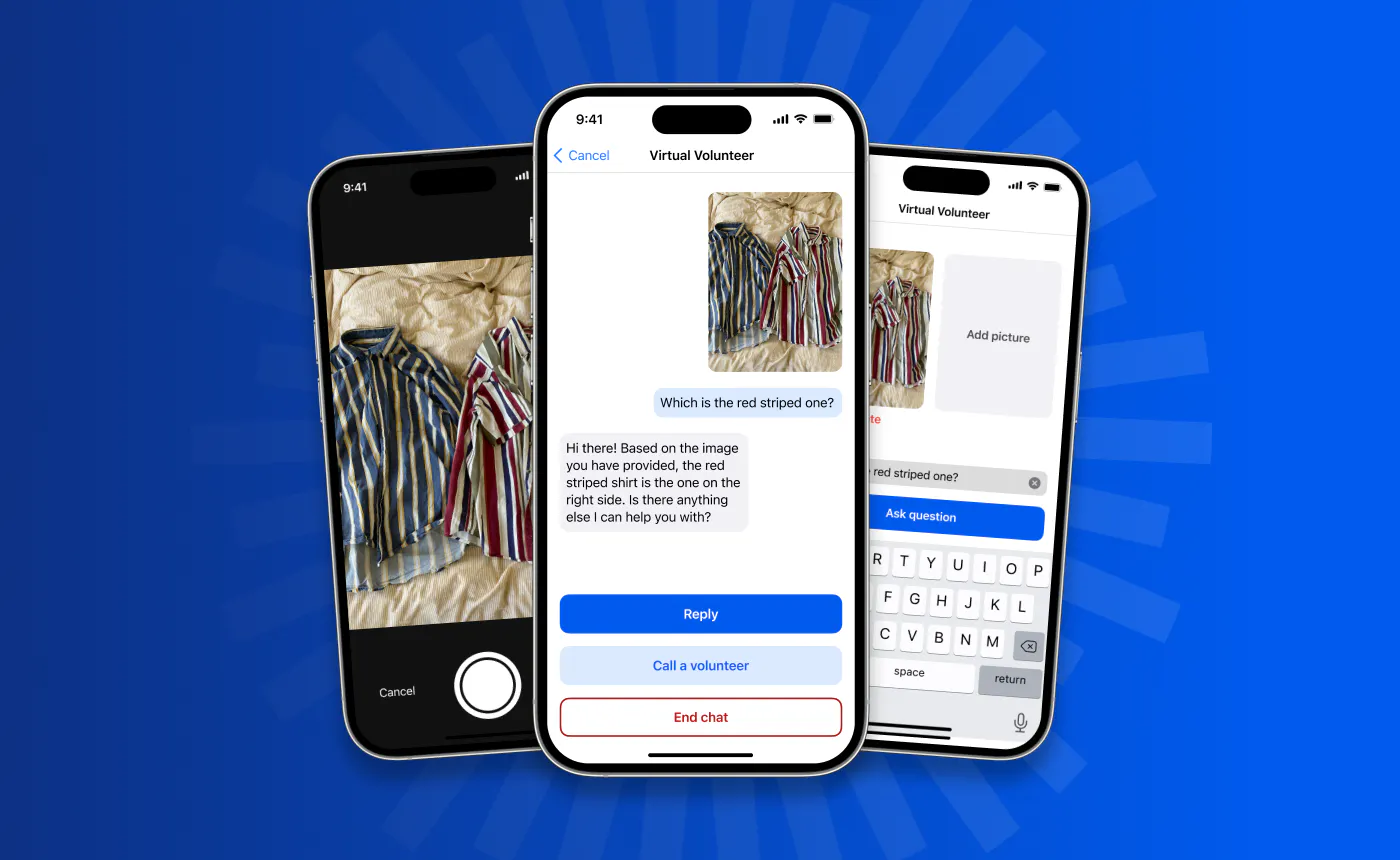
Apps like Be My Eyes' "Virtual Volunteer" demonstrate how multimodal models move beyond object detection and OCR. Users submit a photo or a continuous video stream, and the system:
-
Identifies salient objects (food items, signage, screens)
-
Reads and summarizes text
-
Infers context (e.g., "these ingredients could make a pasta dish")
-
Answers follow-up questions with conversational precision
Wearables like XRAI Glass take this further, pairing ASR with AR displays to caption speech in the user's field of view. These include low-latency, on-device ASR, continuous streaming transcription, diarization (identifying who's speaking), and projection to overlay text in physical space.
These systems need to handle overlapping speech, reverberant rooms, and mixed accents, all in real time.
Assistive vision and speech AI force developers to solve some of the most challenging perception problems:
-
A spoken caption that appears 700ms late is unusable, and a scene description that lags by a second destroys the interaction. Developers must design for sub-200-ms feedback loops.
-
On-device inference is the default privacy posture. Many users cannot (or should not) upload raw video/audio, so models must be optimized to run on mobile GPUs, NPUs, or edge accelerators.
-
Summarization > enumeration. Blind users do not want "There is a table. There is a chair. There is a lamp." They want contextual interpretation: "Your coffee mug is on the far right side of the table, near the edge." This requires multimodal perception + LLM reasoning, not raw detection.
-
Developers must build for not just what the system detects, but how it communicates: concise TTS, AR text, haptic cues, and summaries.
The accessibility domain generalizes to other real-time perception problems. Design constraints developed here, such as low latency, privacy-preserving inference, contextual summarization, map directly to robotics, industrial safety, and autonomous systems.
Temporal AI is Essential for Sports Analytics
Sports environments push vision AI to its limits. Players move at high speed, balls travel even faster, camera angles shift constantly, and multiple events compete for attention. Unlike controlled industrial settings, sports vision AI must track everything while maintaining player identity across multiple camera feeds and delivering insights fast enough for broadcasting, coaching, and officiating.
The challenge isn't just detecting what happened, but understanding the context and significance of each moment. A spike in crowd noise could signal a goal, a near-miss, or a controversial call. A player's sudden deceleration might indicate fatigue, tactical positioning, or injury.
Hawk-Eye (tennis, cricket) and VAR (soccer) use multi-camera triangulation to track ball position and player movements for officiating decisions. Second Spectrum (NBA) and Next Gen Stats (NFL) provide real-time analytics by processing multiple video feeds to track players, ball trajectories, and game events.

These systems combine computer vision with audio processing to create comprehensive game understanding.
-
Player and ball tracking across the entire field of play
-
Automatic offside detection and line-call verification
-
Team formation and spacing analysis
-
Injury risk detection through biomechanical analysis
-
Automated highlight detection using crowd noise and visual cues
The technical requirements for sports perception create unique developer challenges:
-
Single-frame detection is insufficient. Single-frame detection fails when tracking fast-moving players who cluster, occlude each other, or temporarily leave the frame.
-
Sports systems often ingest 8-24+ feeds simultaneously. Officiating decisions require perfect frame alignment across feeds to determine the exact moment of rule violations.
-
Multimodal fusion reduces false positives. Vision identifies player actions, audio captures crowd reactions, and commentary provides semantic context that no single modality can deliver alone.
-
Latency requirements vary by use case. Officiating can tolerate seconds for review, while injury detection must flag risks immediately.
Sports perception systems are blueprints for any fast-moving, multi-agent scenario. The same principles that track basketball players through screens apply to warehouse robots, autonomous vehicles, and drone coordination, but with every decision visible to millions of viewers in real-time.
Frequently Asked Questions
How can I combine vision and audio inputs to interpret real-time events?
You must treat audio as a parallel channel for multimodal fusion rather than relying solely on text. Speech AI captures intent and urgency (e.g., a shouted "Stop!"), while vision AI provides physical context (e.g., a worker in a danger zone). When fused, these inputs allow the system to understand the full context of human intent and machine state.
What's the best architecture for low-latency perception in edge environments?
Edge inference is the required default for safety-critical operations. To meet latency budgets of under 100 milliseconds, you must use on-premise GPU hardware or embedded AI to process data locally. This architecture eliminates cloud round-trips, allowing the vision AI to trigger instant alerts or machine stops immediately upon detecting a hazard.
How can accessibility features use perception AI safely and privately?
Accessibility tools should utilize on-device inference as the default posture to ensure user privacy, avoiding the need to upload raw video or audio. These systems combine vision and speech AI to deliver contextual summaries—interpreting what matters to the user rather than just listing objects—and must operate with sub-200ms feedback loops to remain usable.
What's the difference between industrial and sports vision systems?
Industrial vision AI optimizes for safety and immediate intervention in poorly lit environments with heavy machinery. In contrast, sports vision AI must track high-speed, multi-agent scenarios across 8--24+ simultaneous camera feeds, maintaining player identity and alignment for broadcasting and officiating decisions.
How do I evaluate real-world perception systems for accuracy and reliability?
You should evaluate systems based on "continuous state estimation" (temporal reasoning) rather than single-frame detection, which often fails in dynamic environments. Reliability is achieved through multimodal fusion (combining vision, speech, and sensor data) to stabilize the world model, reduce false positives, and enable the system to predict trajectories and intent.
Building Perception Systems for the Real World
Every deployment faces the same architectural decision tree.
Safety-critical systems like Kajima's construction monitoring require edge inference with sub-100ms latency, processing everything locally on GPUs to avoid network dependencies. Broadcasting and analytics systems can leverage hybrid architectures, using edge devices for initial processing and cloud resources for deeper analysis. Accessibility tools require on-device inference by default, both for privacy and responsiveness, while sports systems often distribute processing across multiple tiers to handle dozens of camera feeds simultaneously.
The convergence of vision, speech, and temporal AI isn't just enabling new applications; it's creating a blueprint for how AI systems interact with the physical world. Developers building these systems are creating the sensory layer that lets AI understand, respond to, and ultimately reshape how we work, play, and live in real environments.