

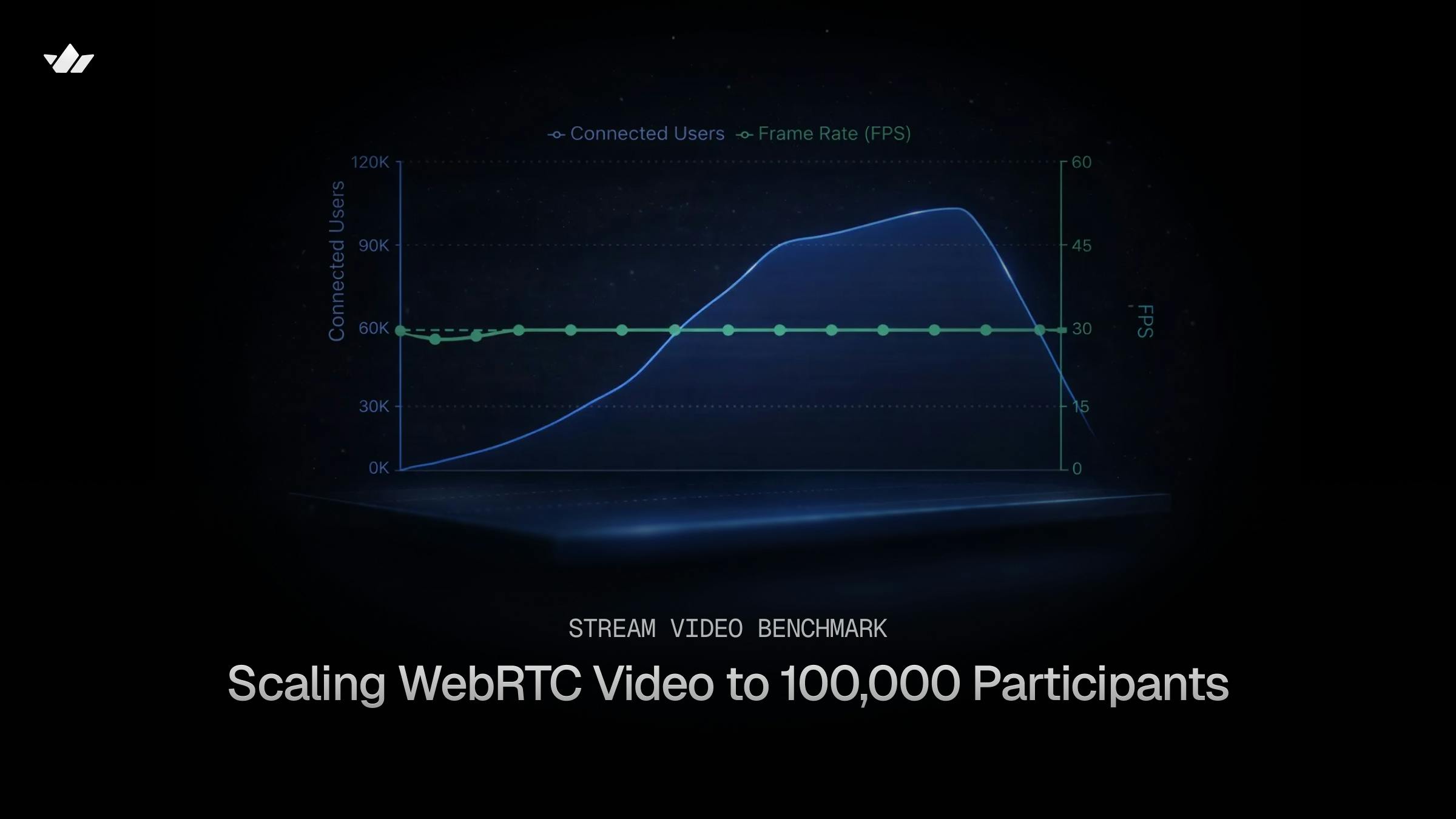
Stream has reached a major milestone in real-time video infrastructure:
Successfully scaling a single WebRTC-based livestream to 100,000 concurrent participants while maintaining ultra-low latency, stable frame rates, and zero packet loss.
Today, Stream powers real-time chat, activity feeds, moderation, audio, and video for applications serving over one billion end users worldwide, backed by a 99.999% uptime SLA for enterprise customers.
Stream Video Benchmarks at a Glance

In this benchmark, Stream simulated a real-world livestream scenario with rapid audience growth and global distribution:
-
100,000 concurrent participants consuming a 1080p WebRTC stream
-
10,000 users joining per minute, peaking at 600 joins per second
-
Participants distributed across six global regions
-
225 Gbps peak traffic handled seamlessly
-
0 API failures, 0 crashes
-
Stable 30 FPS throughout the event
-
0% packet loss, 4ms jitter
See full architecture and benchmark docs.
Performance remained consistent from the first participant to the hundred-thousandth.
And importantly: this benchmark still operates below the upper limits of Stream's video infrastructure. The team is already working toward a one million participant livestream benchmark.
Why Video at This Scale Is Hard
Most video calling and livestream tools are built for small group meetings or one-to-many broadcasting. At scale, real-time video becomes exponentially harder.
WebRTC was originally designed for peer-to-peer communication. In large calls or livestreams, that model quickly breaks down under the weight of bandwidth demands, connection complexity, and real-time delivery constraints.
When tens of thousands of users join simultaneously, even small inefficiencies can cause visible quality degradation, dropped frames, or outright failure.
For live events, creator platforms, sports, education, and large communities, those failures are inconvenient and experience-breaking.
That's why organizations running high-stakes live video events choose Stream.
Built for Massive Live Video, Not Just Meetings
Instead of forcing customers to shard audiences into smaller rooms or accept degraded quality at scale, Stream's architecture enables:
-
Seamless audience growth without reconfiguration
-
Predictable latency even during sudden traffic spikes
-
Efficient bandwidth usage across devices and network conditions
-
Global reliability through multi-datacenter deployments
This allows teams to focus on building differentiated user experiences, not firefighting infrastructure issues during their biggest moments.
Enterprise-Ready by Design
Scaling to 100,000 participants requires reliability, resilience, and operational maturity, not just raw throughput.
The result is a video platform that performs under pressure, whether you're launching a live event, running a global town hall, or powering a fast-growing creator economy.
Proven at Scale, And Still Raising the Bar
Some providers claim support for "large" video calls, but struggle to maintain quality broadcasts at scale. Stream's 100k benchmark demonstrates what's possible when real-time video is treated as core infrastructure, not an afterthought.
For teams that need no-compromise live video at massive scale, Stream Video offers a faster path to production, lower operational risk, and confidence that your platform will perform when it matters most.
If you're planning live video experiences that need to scale today, and grow far beyond tomorrow, Stream Video is ready.