


As agents become more commonplace, new protocols are being invented to simplify and standardize complex workflows. With so many emerging standards, it's increasingly important to know which to use and how they fit together.
This guide breaks down the most widely recognized AI agent protocols and explains how they interoperate, overlap, and complement each other.
What Are AI Agent Protocols?
AI agent protocols are standardized rules that dictate how agents interact with other agents, users, and external systems. They provide a template to discover resources, exchange information, and perform actions.
There are numerous protocols available for both distinct and overlapping functions. All of them share the goal of helping agents work better in complex environments without the need for tight coupling.
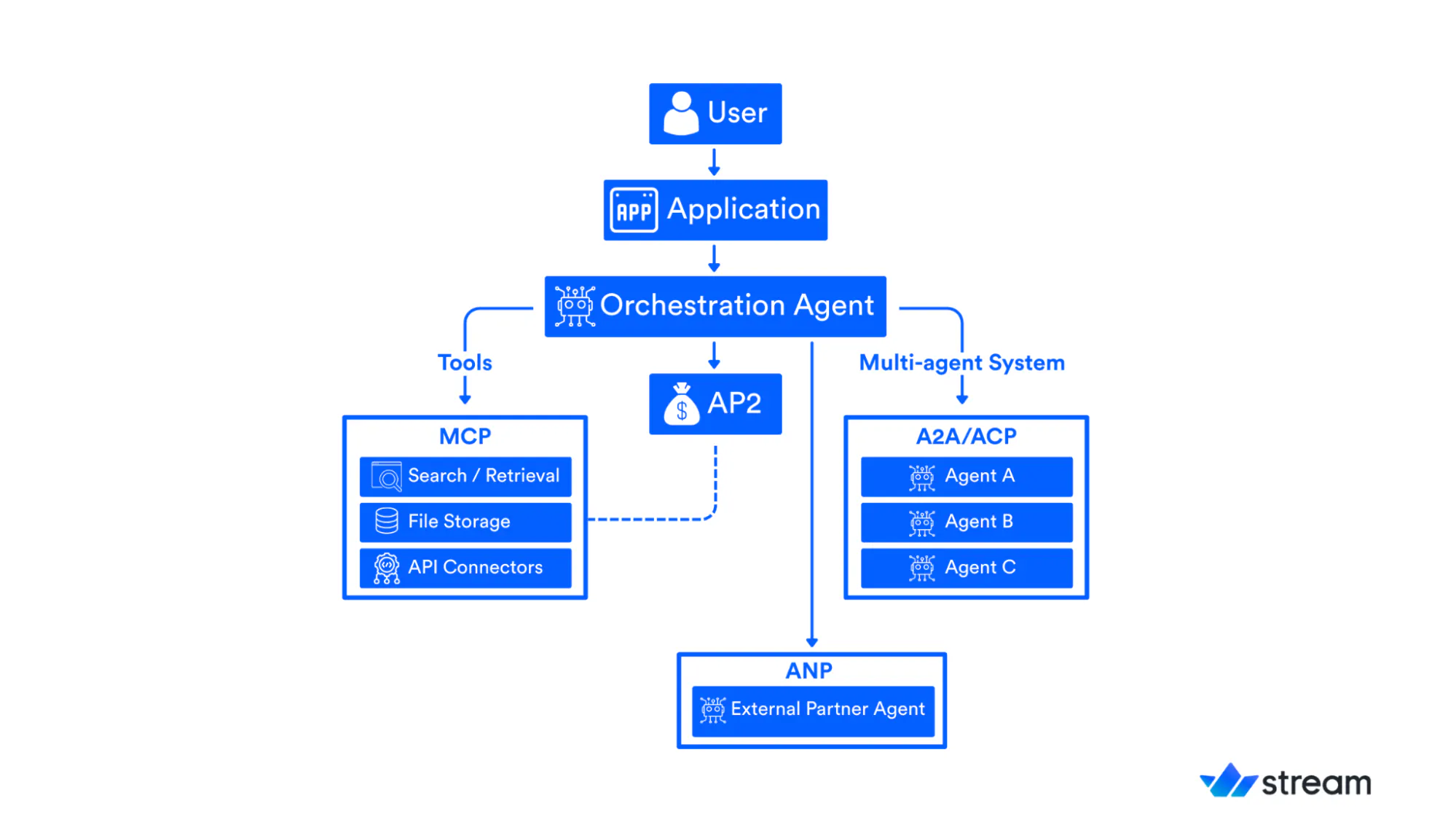
The 5 Most Popular Protocols
Let's take a look at some of the most popular protocols today:
Model Context Protocol (MCP)
The Model Context Protocol (MCP) provides a standardized way for agents to access external resources. MCP focuses entirely on easier integration with APIs, file systems, databases, and more, instead of communication with other agents.
It works by exposing these external systems through dedicated MCP servers. The servers act as intermediaries that describe what capabilities are available and how they can be used. Agents query these servers to discover resources and invoke tools using well-defined schemas. Inputs and outputs are strictly structured, making it easy for agents to reliably parse responses and reason over results.
The protocol also standardizes capability discovery, authentication, and context retrieval.

This structured approach to data handling and resource invocation enables the following key features:
-
Capability Discovery: Agents adapt their behavior based on the exact functions available.
-
Tool and Resource Abstraction: MCP wraps complex systems (like databases and APIs) into standardized abstractions for simpler integration.
-
Structured Context Schemas: A standardized format is enforced to deliver context to the model. This lets agents interpret the same data consistently between tasks.
-
Decoupled Extensibility: Developers can add new data sources or functional tools without having to modify agent logic.
Typical use cases for MCP include querying internal company systems, fetching documentation or knowledge bases for reasoning, and automating workflows that use web browsers, development tools, backend servers, and other utilities.
Agent-to-Agent Protocol (A2A)
The Agent-to-Agent Protocol (A2A) was developed by Google to allow agents to communicate and coordinate tasks in multi-agent workflows.

It manages the lifecycle of a request with a three-step sequence:
-
Discovery: The process begins when a client agent receives a request. It reviews the credentials of all the available remote agents and selects the one best suited for the task at hand.
-
Authorization: After the remote agent is chosen, the system establishes secure access. The client validates permissions and grants the necessary control scopes, making sure the remote agent has the appropriate tools and authority to proceed.
-
Communication: Tasks are dispatched via HTTPS, with the JSON-RPC API protocol as the message envelope. Though data can be sent back to the client agent using polling, streaming through Server-Sent Events (SSE) is more common.
A2A offers the following core features to enhance inter-agent communication:
-
Peer-to-Peer Delegation: Direct task handoffs between agents without centralized bottlenecks.
-
Dynamic Negotiation: Supports complex interaction patterns, including propose, accept, and counter-offer workflows.
-
Streamed Information: Real-time synchronization of event logs and agent states.
-
Standardized Identity: A unified approach to AI agent addressing and cryptographic identity.
This protocol is useful for communication and distributed planning in multi-agent systems.
Agent Communication Platform (ACP)
Much like A2A, the Agent Communication Platform (ACP) also connects AI agents in multi-agent workflows.
The most significant difference is ACP's REST-based communication and agent registries.
ACP also differs from A2A by employing a client-server architecture instead of using peer-to-peer communication. The ACP client is used by agents, applications, or services to make requests to ACP servers, while the servers host one or more agents that execute requests and return results via the aforementioned REST interface.
Here are some of ACP's most useful features:
-
Stateful Messaging Routing: ACP keeps context across the message lifecycle, meaning that messages are routed based on the current status of the agent and the history of the exchange.
-
Easy Setup: Though an SDK is available, ACP can be interacted with using common development tools like cURL, Thunder Client, and Postman.
-
Passive Discovery: Agents publish their metadata at well-known URIs using YAML files, which can be read even when an agent is offline. This allows systems to find them and wake them up only when needed.
-
Inherently Multimodal: ACP supports MIME-typed multipart messages, which allow agents to exchange text, structured data, files, images, and other types of multimodal data.
Some of the best use cases for ACP are flexible agent replacement, cross-platform integration, prompt chaining, and parallelization.
Agent Network Protocol (ANP)
The Agent Network Protocol (ANP) allows agents to communicate with each other directly over the internet.
Instead of building brand new technologies, ANP sits on top of commonly used web protocols and services, like HTTPS for secure connections and DNS for finding addresses. This reduces the workload for integration into existing web projects without needing specialized hardware or closed ecosystems.
ANP uses a three-step process for communication:
-
Discovery: Agents display their capabilities by hosting a file at a specific, predictable URL. Search engines and other agents crawl these files to build a directory that is used to find agents that can perform requested tasks.
-
Authentication: To ensure security, agents use Decentralized Identifiers (DIDs), which allow client agents to prove their identity using a cryptographic signature. The host agent verifies this signature against a public registry.
-
Communication: After verification, the agents communicate using a standardized JSON-LD format. This format allows them to add context tags to information, such as sending over "price: 100" to describe data instead of just sending "100."
ANP's public communication structure provides the following core functionality:
-
Decentralized Identifiers (DIDs): Using W3C standards, every agent is assigned a unique, verifiable identity.
-
Semantic Discovery and Description: Agents publish metadata using JSON-LD, which allows other agents to read their capabilities.
-
End-to-End Encryption: All data sent is encrypted between the sender and the receiver. Even if information passes through several servers, only the agents involved have the keys to read the content.
-
AI-Native Interactions: Unlike legacy systems that require agents to scrape websites, ANP provides machine-friendly interfaces, which let agents interact directly with digital services.
ANP's main use case is enabling agents from different companies to work together safely, such as an AI assistant talking to a commerce agent to find products.
Agent Payment Protocol (AP2)
Agent Payment Protocol (AP2) is another protocol developed by Google. It provides a secure way for agents to complete financial transactions.
Its primary goal is to make sure that an agent only performs authorized transactions, even if a human isn't there to oversee it.
Instead of granting full account access, users sign a limited digital contract that defines exactly how much the agent is allowed to spend.
To keep the user in control, AP2 uses three different types of credentials:
-
Cart Mandates (Active Presence): Used when the user is present during a transaction. For instance, if you say, "Find me an electric razor under $100," the agent fills the cart, but you must sign off before any money moves.
-
Intent Mandate (Preapproval): Used for tasks where the human might not be present during the transaction. For example, if you say, "Buy concert tickets as soon as they go live", you sign a mandate ahead of time to act as proof of permission for that purchase.
-
Payment Mandate: Used to prove to banks and payment systems that the transaction was handled by an authorized agent and follows the rules of the previous two mandates.
In an AP2-enabled commerce system, responsibilities are strictly separated so no single entity has too much power. Here are the components that a typical shopping workflow uses:
- Shopping Agent: An agent that acts as the coordinator. It finds products and assembles cards but never sees users' financial details.
- Merchant Endpoint: A specialized tool on the seller's side that negotiates the price and availability with the shopping agent.
- Credentials Provider: A secure digital wallet that manages payment information. It only releases a token to the merchant once the mandate is verified.
- Merchant Payment Processor: A system that handles the final communication to request funds from the payment system.
- Network and Issuer: The bank or credit card network that performs the final fraud check and moves the money.
AP2's architecture enables the following core features:
-
Payment Agnosticism: AP2 works across traditional banks, digital wallets, and blockchain-based currencies.
-
Role-Based Security: By separating agents and credential systems, AP2 keeps payment systems secure even if an agent is subject to a malicious attack.
-
Cryptographic Mandates: Mandates provide a tamper-proof, digitally signed contract that serves as both deterministic proof of intent and a paper trail.
-
Collision Prevention: AP2 ensures that an agent doesn't accidentally buy the same item twice or misinterpret a search request as a buy request.
Example use cases for AP2-enabled agents include automatically purchasing limited items, corporate agents restocking office supplies once inventory hits a certain threshold, or negotiating and renewing service contracts within a budget.
Comparison Chart
| Protocol | Primary Function |
|---|---|
| Model Context Protocol (MCP) | Standardizes how agents access external systems and resources using structured schemas and capability discovery. |
| Agent-to-Agent Protocol (A2A) | Enables direct, peer-to-peer communication and task delegation between agents, supporting discovery, authorization, negotiation, and real-time coordination. |
| Agent Communication Platform (ACP) | Provides REST-based, registry-driven agent communication with strong support for stateful messaging, flexible deployment, and easy cross-platform integration. |
| Agent Network Protocol (ANP) | Enables internet-wide collaboration using semantic discovery, DIDs, and end-to-end encryption. |
| Agent Payment Protocol (AP2) | Allow agents to securely perform autonomous financial transactions using cryptographically signed mandates that prove intent and authorization. |
Other AI Agent Protocols
Having gone over the most mainstream AI agent protocols, let's look at some more niche examples and why they've failed to gain as much traction:
| Protocol | Description | Shortcomings |
|---|---|---|
| Agent-User Interaction (AG-UI) | A protocol for connecting AI agents to user interfaces. It standardizes how agents stream messages, events, tool calls, and state updates to frontend apps using SSE or WebSockets. | Requires UI and agent backends to explicitly support AG-UI event formats. |
| Trusted Agent Protocol (TAP) | A commerce-focused protocol that lets agents prove they are trusted and authorized during checkout and payment flows. | In its early stages and outshined by AP2. |
| Foundation for Intelligent Physical Agents (FIPA) | An early standard for multi-agent systems that defines how they send structured messages using a formal agent communication language. | Largely legacy and academic; not designed for modern LLM-based agents or web-native systems. |
| Language Model Operating System (LMOS) | A protocol and platform that acts like an "OS for agents", defining how agents and tools are discovered, identified, and connected across networks. | Broad and complex, tooling and adoption are still evolving, and inconvenient to use with existing systems. |
| Agora | A decentralized protocol for agent-to-agent communication that focuses on efficiency and scalability, letting them communicate with a central controller. | In its early stages and outshined by protocols with wider adoption like A2A and ACP. |
The Interoperability of AI Agent Protocols
AI agent protocols aren't meant to be used as standalones; they are built to complement each other. Let's look at which protocols you should use at different communication layers.
Networking and Discovery
This layer deals with how agents find other agents, identify capabilities, and establish secure communication channels.
ANP is the best general fit for this stage. It works great for inter-company agent communication, while also being configurable for a more local setup.
A2A and ACP also fit this category, though implementing both in a single application isn't recommended, as they solve the same problem with different tools.
For a catch-all discovery and networking system, developers can integrate both ANP and either A2A or ACP.
Context and Tool Use
The context and networking layer is where AI agents access tools and information.
MCP is purpose-built for this task, as it allows for both tool use and structured context delivery. The only other protocol that complements MCP's capabilities at this layer is AP2 when commerce systems are involved.
Messaging and Coordination
This layer focuses on how autonomous agents exchange tasks, negotiate, send updates, and coordinate work.
A2A, ACP, and ANP fit this layer best, as they are designed for communication and negotiation in agentic systems. They all have structured messaging models, task delegation, and lifecycle updates.
Frequently Asked Questions
What Are the 7 Types of AI Agents?
The seven types of AI agents are:
-
Simplex Reflex Agents
-
Model-Based Reflex Agents
-
Goal-Based Agents
-
Utility-Based Agents
-
Learning Agents
-
Hierarchical Agents
-
Multi-Agent Systems
Which Is the Most Powerful AI Agent?
The most popular AI agents are comparable when it comes to power, but they all have their unique specialties. There's no singular "most powerful" agent. Still, if you require a ranking of the most powerful ones, you can find it on Galileo AI's leaderboard.
What Are the Big 4 AI Agents?
Gemini, Claude, Devin, and LangChain agents were listed as the four biggest by market share in 2025.
Is ChatGPT Considered an AI Agent?
ChatGPT gained popularity as just an LLM, but OpenAI introduced agentic AI functionality in July 2025 with the ChatGPT agent.
What Is the 30% Rule in AI?
The 30% rule of AI is a guideline that AI tools should help with no more than 30% of a project, and the rest of the effort should come from the user.
The Future of AI Agent Protocols
AI agent protocols are evolving quickly, but no single standard is likely to dominate. Instead, modern agentic systems will combine multiple protocols across different layers of responsibility, from discovery and communication to tool use and payments.
As agents take on more autonomous, long-running tasks, clear separation of concerns is increasingly important. Networking and identity protocols handle trust and reach, communication protocols coordinate work, context and tool protocols govern system access, and payment protocols enforce intent and authorization.
While individual standards may change, these architectural patterns are likely to persist.
For developers, the most important takeaway is to design agent systems that remain modular. Favor protocols with explicit schemas, clear permissions, and replaceable components, and avoid tightly coupling agents to specific vendors or runtimes. Understanding how today's protocols fit together makes it easier to build systems that can adapt as the landscape continues to change.