
Same Trends, Bigger Crowd: Inside Prediction-Market Chat During the 2026 World Series


At 12:13am ET on October 28, the Milwaukee Brewers were three outs from winning the World Series. They led the Tampa Bay Rays 3-2 in the bottom of the 12th inning of Game 4.
The Rays put two runners on. At 12:24am, Jonny DeLuca singled to tie the game. Four minutes later, Ben Williamson drove in the winning run with a walk-off single, giving the Rays a 4-3 victory.
We watched the same four minutes in the chat data of two of the largest prediction markets running on Stream. At 12:28am, users of the larger platform sent 1,418 messages in one minute, about twice its pace earlier in the inning. The second platform hit 1,182 messages a minute at 12:29am, more than double its earlier pace. Nearly 1,000 people posted in that single minute on the larger platform alone.

Game Nights Looked Like Normal Nights
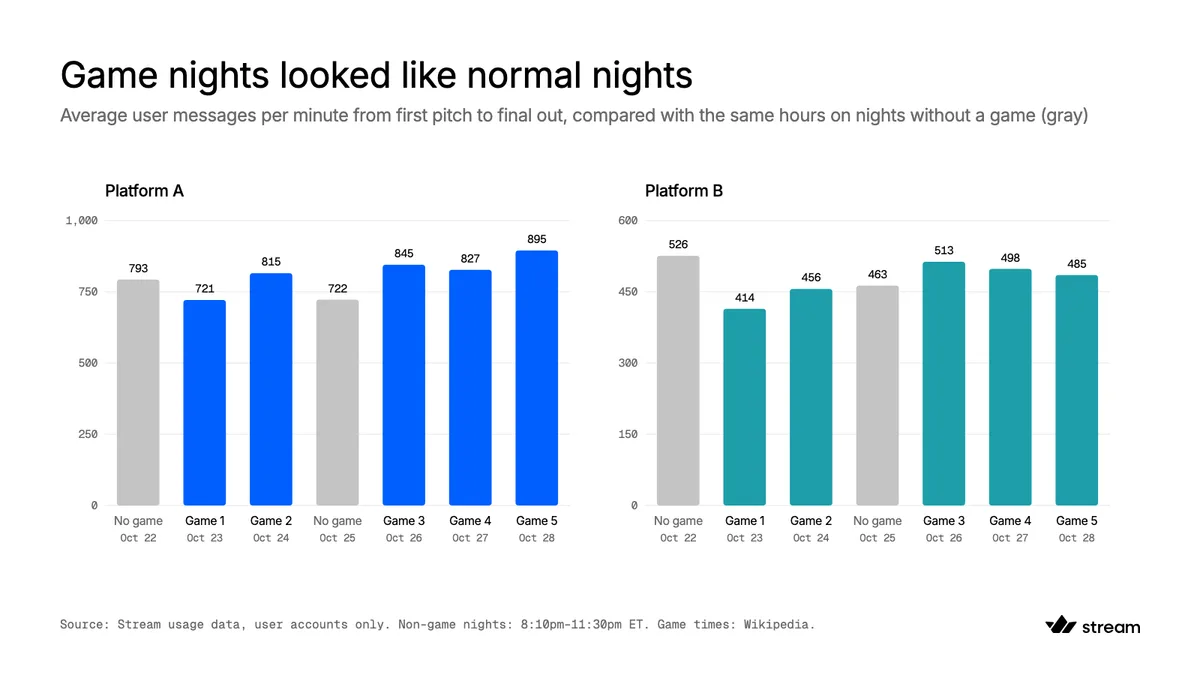
We compared the five World Series games (October 23 - 28) with nights in the same weeks when no game was played.
During the games, the larger platform averaged 721-895 messages per minute. On two nights without a game, over the same hours, it averaged 722 and 793. The second platform averaged 414-513 messages per minute during games and 463-526 on nights without one.
Across whole days, the situation was the same. On game days, message volume was 7% above a typical day on the larger platform and 17% above on the second platform. AI text moderation checks ran 4-6% above typical levels.
The spikes were real but short. The walk-off minute was the exception, and it lasted a few minutes. Over a full game night, total chat volume stayed within the range of a normal weeknight.
The Kinds of Harm Did Not Change
We've seen many trust and safety teams treat a championship game as a different kind of event. They add reviewers or write rules specifically for that night.
However, our data suggests different moderation policies aren't needed.
Across our prediction-market customers, Stream AI Moderation made 50,985 detections on October 23 (Game 1), 27,554 on October 24 (Game 2), and 35,605 on October 25, when there was no game. Volume moved from day to day, and not always with the games; Game 2 had fewer detections than the day without a game. The mix of harm categories stayed the same. Insults were 30 - 31% of detections on all three days, vulgarity 28%, racism 10 - 11%, sexual harassment 6 - 7%, ableism about 4%, and self-harm under 1%. No category shifted by more than one percentage point.
In other words, a big game changed how much content needed to be moderated, but not what kind. So, the policies that you typically use work just as well on a game night.
What the Platform Handled
These moderation policies are only as good as the system running them. Across the five game days, Stream handled the following for these two platforms:
- About 711 million chat API calls
- About 35 billion real-time events delivered to users' devices
- About 6.9 million moderation API calls, including about 5 million AI text checks
- Over the full series (October 23 - 28), 7.2 million user messages from more than 300,000 user accounts
The busiest day was October 24, the day of Game 2. The larger platform made 128 million API calls that day, 1.5 times as many as on a normal day, with no server errors. On every game day, for both platforms, server errors stayed at or below 0.001% of requests. Error rates on game days were no higher than on normal days.

Football Days Were Bigger
The World Series was not the busiest event in this period. For the larger platform, the day with the most active users was Sunday, October 25. This day had 1.12 million people, even without a World Series game but with a full NFL schedule. Its highest count of concurrent users came on October 4, also an NFL Sunday.
Prediction markets run many events at once. A World Series game lands on top of football, basketball, and politics. You shouldn't plan for one event in isolation, as you'll miss where the chat spikes actually come from.
What This Means for Trust & Safety Teams
- Set policies from normal traffic. On these platforms, game nights did not bring new types of harmful content. Policies that handle a typical night's content mix also handle a championship night.
- Expect short, sharp spikes. Volume rose for a few minutes around big plays, then returned to its usual level. Moderation needs to keep pace during those minutes without anyone stepping in.
- Scale should not depend on staffing. Automated moderation that scales with message volume keeps up during spikes. Human reviewers can focus on edge cases and appeals rather than volume.
- Plan for overlapping events. The busiest days came from several events at once, not one headline game.