

Over the past few years, building software has become dramatically easier.
With AI-assisted development, you can scaffold features, generate APIs, and ship working prototypes in days, not months. For product and engineering leaders, this has quietly reshaped one of the most familiar questions in software:
Should you build in-house, or buy it?
In-app communication across chat, video, and feeds is one area where that question tends to surface quickly.
In the sections that follow, we'll break down how this decision has evolved in 2026, including a full cost analysis and decision framework.
The Build vs. Buy Question Changed
In the past, the build vs. buy decision was mostly about feasibility. Could your team realistically build this feature with the time and resources available?
Today, that question matters far less.
With AI-assisted development, most teams can build something quickly. The harder question is whether you're prepared to own what you build over time, especially when it comes to real-time communication.
Once a communication feature is live, it becomes an always-on system with expectations around reliability, performance, and safety. Early success can be misleading. As usage grows, so do edge cases, abuse patterns, and infrastructure demands. What started as a lightweight feature begins to require sustained investment across engineering, infrastructure, and product teams.
The modern build vs. buy decision involves determining whether owning and operating a communication system is the best long-term use of your team's engineering time, especially if you only need a basic chat experience and your users don't expect communication to be a differentiated or social part of the product.
Why Should You Care?
In-app communication is something users expect to work flawlessly.
When it feels slow, unreliable, or bolted on, it immediately affects how your product is perceived.
The strongest products treat communication as a core part of the experience. In those products:
-
In-app chat feels instant and reliable
-
Activity feeds update in real time
-
Video works when it's needed
-
Moderation is present, but largely invisible
Failures no longer feel like minor bugs. The impact shows up quickly across late messages, laggy feeds, and high-latency video. Over time, those experiences affect trust, engagement, and retention.
That reality is what makes the build vs. buy decision increasingly consequential.
Quick Look - In-House vs. Third-Party
Before diving deeper, let's clarify what teams are really choosing between. Building in-house and using a third-party API solve different problems and come with different tradeoffs.
| Dimension | Building In-House (+ AI Tools) | Using a Third-Party API |
|---|---|---|
| Primary strength | Speed of development | Reliability at scale |
| Best for | Prototyping, scaffolding, iteration | Production systems |
| Time to v1 | Days | Days to weeks |
| Time to maintain | Ongoing, internal | Largely outsourced |
| Scalability | Manual, case-by-case | Built in from day one |
| Reliability | Depends on your team | Defined and supported |
| Security & compliance | Fully owned internally | Shared responsibility |
| Moderation & abuse | Must be built and maintained | Often seamless add-on |
| Cost profile | Low upfront, rising over time | Predictable, usage-based |
| Risk surface | Increases as usage grows | Largely externalized |
The sections that follow break down where teams tend to underestimate these tradeoffs and how those decisions compound over time.
AI-Assisted Development: Is It Worth It?
Tools like Copilot, Cursor, and internal LLMs make it possible to scaffold functionality, wire up APIs, and ship early versions of features at a pace that wasn't realistic just a few years ago.
That speed is real, but it's also deceptive.
AI (or vibe coding) dramatically accelerates creation, not responsibility. The systems you ship still need to be run, scaled, secured, and supported in production.
What often gets missed is the hidden cost curve that follows early success. As usage grows, leadership is left owning:
-
Ongoing infrastructure and operational overhead
-
Higher reliability expectations from users
-
Safety, abuse, and moderation challenges
-
Opportunity cost as internal teams stay tied to maintenance
AI/ vibe coding are well-suited for early-stage work. They help teams scaffold APIs and schemas, build UI and client logic, and accelerate basic workflows.
Where AI falls short is at the system level. It does not:
-
Guarantee correctness or consistency at scale
-
Solve edge cases that emerge under real-world usage
-
Handle abuse, spam, or adversarial behavior
In fact, AI-generated content often increases moderation risk. As it becomes easier for users to generate and share content, the surface area for misuse grows faster than most teams can secure it.
What Happens After v1
Imagine you decide to vibe code your first product iteration. At that point, very few teams set out to build multiple communication systems. Most start with a single use case, often chat, and expand from there as the product grows.
As usage increases, new needs emerge:
-
Users expect WhatsApp-level chat experiences, so 1:1 chat expands into group messaging, channels, or community-style discussions
-
One-off messages become persistent conversations
-
Simple chat leads to social feeds
-
Collaboration and support workflows introduce moderation requirements
-
Video or live interaction becomes part of the experience
Each new surface adds complexity. Infrastructure grows more fragmented. Data consistency becomes harder to maintain. Safety and trust requirements multiply across products.
When these systems are built independently, teams end up solving the same problems multiple times (scaling, reliability, permissions, moderation) across different communication surfaces.
This is where many teams feel the weight of early build decisions. What began as a fast, isolated implementation turns into a collection of systems that all need to be operated, monitored, and maintained together.
What Teams Underestimate When They Build In-House
| Area | What Teams Expect | What Actually Happens |
|---|---|---|
| Scale | “We’ll optimize later” | Usage spikes force infrastructure rewrites |
| Reliability | “99% is fine” | Users expect near-perfect uptime |
| Moderation | “We’ll add filters” | Abuse evolves faster than rules |
| Compliance | “Not needed yet” | Enterprise requirements force retrofits |
| Product scope | “Just chat” | Feeds, video, and notifications follow |
Cost of Build vs. Buy
Below are two scenarios for a product team adding in-app communication:
-
Building in-house with AI assistance
-
Using a third-party API
Scenario 1: Building In-House (AI-Assisted)
Assumptions:
-
Moderate-scale product (B2B SaaS or consumer app)
-
Real-time chat as the starting point (costs will increase with additional features)
-
AI-assisted development using tools like Copilot, Cursor, or internal LLMs
-
Reduced headcount during initial build
Year 1: Engineering & Tooling Costs
| Role / Tool | Assumption | Annual Cost (Est.) |
|---|---|---|
| Backend engineers | 1 - 2 | $180k - $440k |
| Frontend engineer | 1 | $160k - $190k |
| DevOps / infra | 0.5 | $95k - $115k |
| Product / QA overhead | — | $80k - $120k |
| AI tooling | 3 - 5 seats | $5k - $15k |
| Year 1 total | $520k - $880k |
Notes:
Infrastructure & Operational Costs (Annual)
Even with AI-assisted development, real-time systems require always-on infrastructure.
| Category | Annual Cost (Est.) |
|---|---|
| Compute & real-time servers | $40k - $90k |
| Databases & storage | $25k - $60k |
| Networking, CDN, observability | $20k - $50k |
| Infra total (annual) | $85k - $200k |
Note:
- (Cloud cost patterns based on common AWS/GCP usage for real-time workloads.)
Ongoing Maintenance (Years 2 - 3)
Once live, most teams need dedicated ownership.
| Cost Area | Annual Cost |
|---|---|
| 1 - 2 engineers for maintenance | $180k - $360k |
| Infra growth & reliability | $100k - $250k |
| Moderation, safety, compliance work | Embedded cost |
| Annual ongoing cost | $300k - $600k |
3-Year Total: In-House Build
| Category | Estimated Cost |
|---|---|
| Engineering & tooling | $1.0M - $1.4M |
| Infrastructure | $300k - $600k |
| Ongoing maintenance | $600k - $1.0M |
| 3-year total | $1.9M - $3.0M |
This assumes:
- AI reduces initial staffing needs
- No major rewrites
- Moderate (not explosive) growth
Scenario 2: Using a Third-Party API
Using an API shifts most operational responsibility outside your team. Engineering effort is front-loaded into integration rather than long-term ownership.
Typical Cost Structure
| Cost Area | What You Pay For |
|---|---|
| Engineering | Integration and product customization |
| Infrastructure | Included |
| Reliability & uptime | Included |
| Moderation & abuse tooling | Often included or seamless add-on |
| Scaling costs | Usage-based |
Typical Annual Costs
| Category | Assumptions | Annual Cost (Est.) |
|---|---|---|
| Integration engineering | Partial team, short-term | $80k - $150k |
| API subscription fees | ~50k - 250k MAU | $30k - $150k |
| Annual total | $110k - $300k |
Note:
- Costs scale with usage, not headcount.
3-Year Total: API Approach
| Category | Estimated Cost |
|---|---|
| Engineering (integration) | $200k - $300k |
| API usage | $90k - $450k |
| 3-year total | $290k - $750k |
Side-by-Side Summary
| Category | In-House (AI-Assisted) | Third-Party API / (50k - 250k MAU) |
|---|---|---|
| Time to v1 | Fast | Fast |
| Long-term ownership | Internal | Externalized |
| Cost predictability | Low | High |
| 3-year cost range | $1.9M - $3.0M | $290k - $750k |
| Ongoing engineering load | High | Low |
| Risk exposure | Accumulates | Largely transferred |
Summary:
- AI meaningfully lowers the cost to start. It does not eliminate the cost of owning real-time communication once users depend on it. That gap widens further as communication expands beyond a single surface. Adding activity feeds, notifications, video, or moderation multiplies infrastructure, reliability, and safety requirements, often turning one system into several that all need to be operated together.
- The gap between build and buy comes down to how much operational complexity you want your team to carry over time.
Real-World Examples
Real products paint a clearer picture of how communication features evolve and why ownership matters. Below are concrete examples from teams that faced growth or performance challenges tied to in-app communication.
Shiftflow: Synchronized Workstreams Across Products
Shiftflow used real-time communication to keep distributed teams aligned across workstreams. Instead of siloed updates, the team integrated real-time feeds and notifications into multiple workflows, increasing collaboration without sacrificing reliability.
Because Shiftflow chose a proven communication foundation, they could add new interaction surfaces without rebuilding core systems.

Takeaway: When communication is embedded across products and workflows, a solid infrastructure lets teams innovate without reinventing the base layer.
Nextdoor: Community & Scale
Nextdoor originally maintained an in-house chat solution, but it became resource-intensive and limited in feature set.
They faced challenges fostering engagement and community interaction, particularly as usage scaled. Choosing a scalable communication platform enabled them to focus engineering effort on product experience rather than re-solving core messaging infrastructure.
Takeaway: Once community and engagement grow, maintaining reliable communication infrastructure internally becomes a major investment.
7shifts: Team Messaging Drives Engagement
7shifts, a workforce management platform for restaurants with over 55,000 teams using the product, saw measurable improvements after integrating a production-grade chat service.
Rather than doubling down on an internal build, they leveraged a third-party service to support real-time team communication and saw a 7% increase in team messaging usage.

Takeaway: Production solid real-time communication can meaningfully lift engagement metrics when it's reliable and well integrated.
Good Doctor: Speed & Feature Expansion
Good Doctor, a telehealth platform, improved response times and usability by integrating real-time communication components.
Leveraging a scalable communication foundation allowed the team to focus on higher-order capabilities, like notifications, queue management, and performance, rather than building low-level messaging infrastructure. They're also positioned to add video consultations in the future without rebuilding core systems.
Takeaway: Using durable building blocks for communication lets teams unlock new modalities (e.g., video) without re-architecting the entire stack.
What These Examples Illustrate
Across industries, we see three patterns:
- Communication quickly becomes a differentiator.
- Expansion beyond basic chat (feeds, video, moderation) increases operational load.
- Product teams save time and risk when they leverage stable, scalable infrastructure rather than reinvent it.
~
In each case, the choice to adopt production-grade communication infrastructure helped teams go faster and focus on what uniquely differentiates their product.
Build vs. Buy Decision Framework
There's no universally "right" answer to building or buying communication infrastructure. The right decision depends on what you want to differentiate on and what you're prepared to own long-term.
Use the framework below to assess your approach.
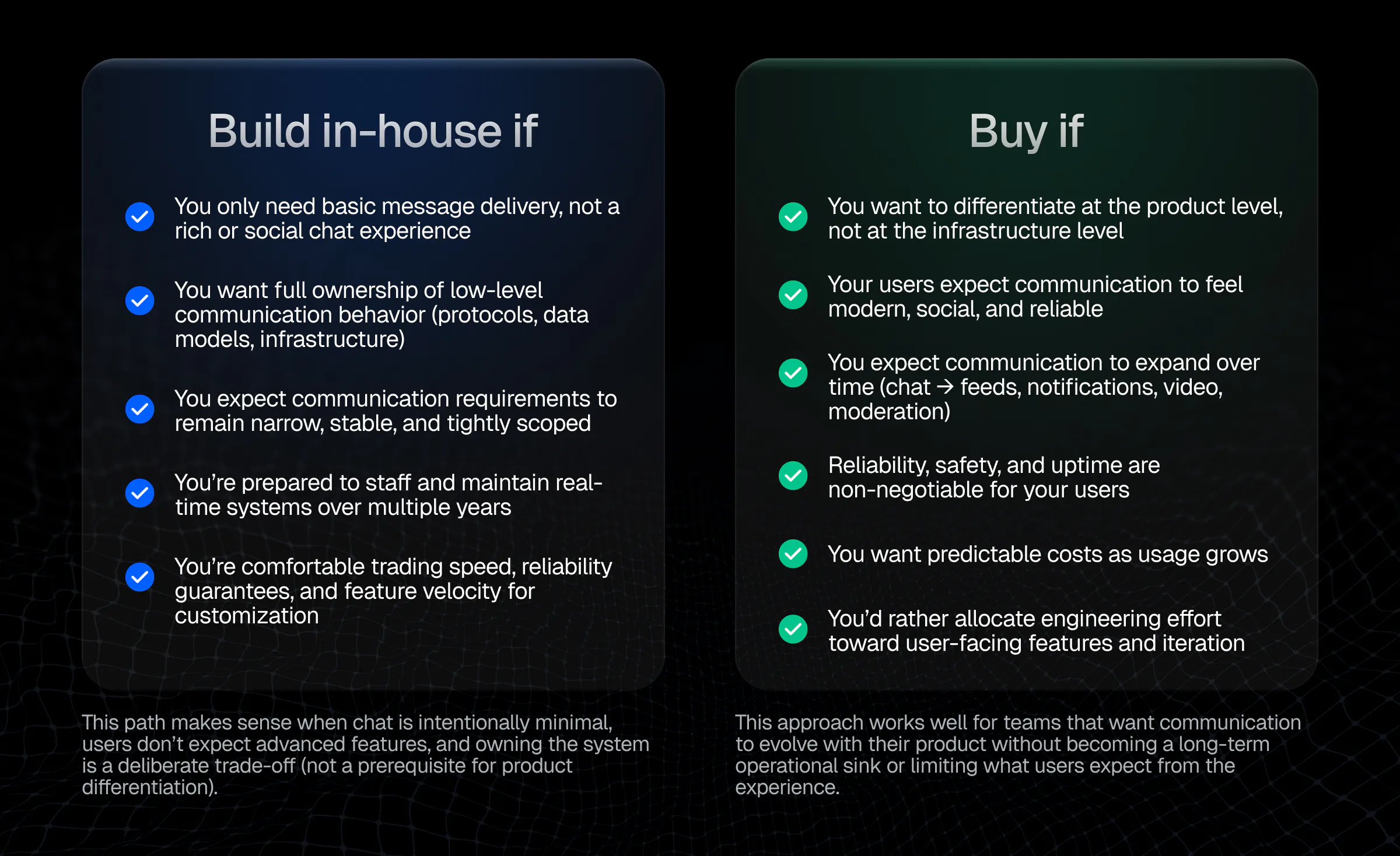
When making the build vs. buy decision, ask yourself:
-
Are we trying to invent new interaction patterns, or deliver great experiences reliably?
-
Are we aiming for a basic, utilitarian chat experience, or do our users expect communication to feel social, polished, and feature-rich?
-
Do we want to spend engineering cycles maintaining infrastructure or improving the product users see?
-
If usage doubles, are we confident our current approach scales without major rework?
The clearer those answers are, the clearer the build vs. buy decision becomes.
Final Takeaway
Building software is easier than it's ever been.
Owning real-time communication in production is not.
AI and vibe coding have lowered the barrier to getting features live, but they haven't changed what users expect once they depend on them. Reliability, performance, safety, and scale still require long-term investment, especially as communication expands across chat, feeds, video, and moderation.
It's also worth clearing up a few common misconceptions:
-
Buying doesn't mean giving up control of the product experience. You still own the UX, workflows, and interaction patterns.
-
Building doesn't mean you'll automatically move faster long-term. Initial velocity often gives way to ongoing maintenance, scaling work, and feature parity gaps.
-
Communication being central to your product doesn't mean you should build it from scratch. Even core products can benefit from offloading reliability, safety, and real-time complexity.
The build vs. buy decision comes down to ownership and product scope. It's about deciding where your team's time creates the most value, and where complexity quietly compounds in the background.