# Attachment actions
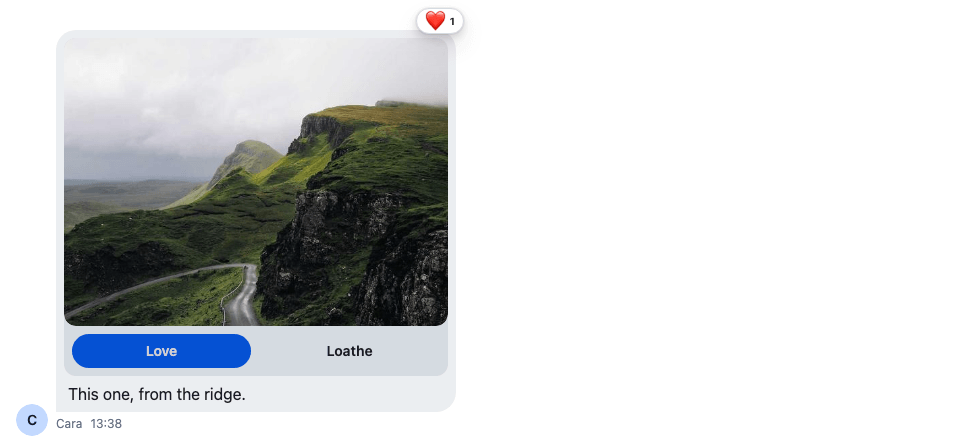
An attachment can carry actions: buttons the message shows under the attachment, such as a Giphy preview's Send, Shuffle and Cancel. This recipe adds actions of its own to images, as a demo of how far attachments stretch rather than a common use case.
>
> **Note:** **What you'll build**
>
> - Love and Loathe buttons under every sent image
> - A click that reacts to the message, and another that undoes it
> - Pressed buttons for reactions the user has given
>
---
**Preview**
---
**Approach:** Replace one part and Change behaviour in the state layer. [Choosing where to start](https://getstream.io/chat/docs/sdk/react/ui-cookbooks/overview/#choosing-where-to-start) explains the approaches.
**Starts from:** [the base app](https://getstream.io/chat/docs/sdk/react/ui-cookbooks/overview/#the-base-app). The page shows only what the recipe adds.
These are actions on attachments in the message list. The menu that adds attachments in the composer is a different thing, the attachment selector's action set, explained in [Attachment Selector](https://getstream.io/chat/docs/sdk/react/component-reference/message-composer/attachment-selector/#custom-action-sets).
The recipe has two parts:
1. The composer adds the actions to each image when the message is sent, with a composition middleware.
2. The message list renders them with an `AttachmentActions` of your own. A click reacts to the message, which the server stores like any reaction, instead of sending the action with `Channel.sendAction()`.
## Best practices
- Add the actions in a composition middleware, in the composer setup function. Every composer then adds them, in channels and threads alike, and both `message` and `localMessage` get them.
- Replace `AttachmentActions` through the `Attachment` component, and render the default for other attachments, so Giphy previews keep their buttons.
- Handle your own actions in your component. The default `AttachmentActions` sends a click to the server with `Channel.sendAction()`, which only handles built-in actions such as Giphy's.
- Expect actions on a single image only. A message with several images shows them as a gallery, without actions.
- Pick reaction types the reaction list knows. The message shows only the types in its reaction options: `haha`, `like`, `love`, `sad`, `wow` and `fire` by default.
## Custom actions
An action is an `Action` from `stream-chat`: `name`, `text` and `type`, and optionally `value` and `style`. Each button's `value` here is the reaction it posts:
```ts title="src/voteActions.ts"
import type { Action } from "stream-chat";
export const voteActions: Action[] = [
{ name: "vote", text: "Love", type: "button", value: "love" },
{ name: "vote", text: "Loathe", type: "button", value: "sad" },
];
```
## Custom AttachmentActions
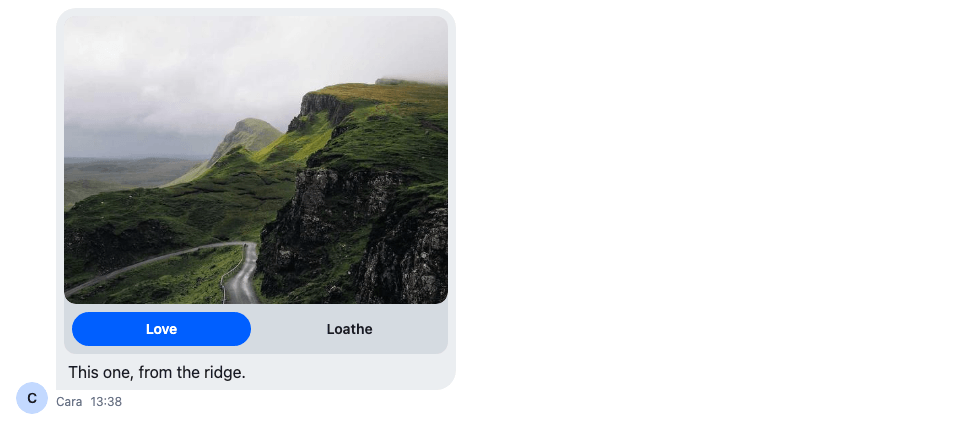
`AttachmentActions` receives the attachment's fields, including `type`, and its `actions`. For images, this one renders an SDK `Button` per action, a solid one for "Love" and an outlined one for "Loathe", and each click reacts through `handleReaction` from `useMessageContext()`. Every other attachment gets the default:
```tsx label="React" title="src/VoteAttachmentActions.tsx"
import type { AttachmentActionsProps } from "stream-chat-react";
import {
AttachmentActions,
Button,
useMessageContext,
} from "stream-chat-react";
import "./VoteAttachmentActions.css";
export const VoteAttachmentActions = (props: AttachmentActionsProps) => {
const { actions, type } = props;
const { handleReaction, message } = useMessageContext();
if (type !== "image") return ;
const ownReactionTypes = new Set(
message.own_reactions?.map((reaction) => reaction.type),
);
return (
{actions.map((action) => (
))}
);
};
```
```css label="CSS" title="src/VoteAttachmentActions.css"
@layer stream-overrides {
.cookbook-vote-actions {
display: flex;
gap: var(--str-chat__spacing-xs);
padding: var(--str-chat__spacing-xs);
}
.cookbook-vote-actions__button {
flex: 1;
}
}
```
The rules sit in the `stream-overrides` layer, so they win over the SDK's own rules once the SDK's stylesheet is in an earlier layer, as [Theming → CSS layers](https://getstream.io/chat/docs/sdk/react/features/app-experience/theming/#css-layers) sets up. They take their spacing from the SDK's tokens, and the buttons take their colors from the SDK's `Button`, so both follow your theme.
`handleReaction` toggles: a second click on "Love" removes the user's love reaction. It updates the message at once and undoes the change if the request fails. `aria-pressed` tells screen readers which buttons are on: a button is pressed while `message.own_reactions`, the user's own reactions to the message, holds its reaction type.
---
**The buttons before a click**
---
## Custom Attachment
`Attachment` renders the attachments of a message and takes its parts as props. Pass it the new actions, and register the result as the `Attachment` override:
```tsx title="src/VoteAttachment.tsx"
import type { PropsWithChildren } from "react";
import type { AttachmentProps } from "stream-chat-react";
import { Attachment, WithComponents } from "stream-chat-react";
import { VoteAttachmentActions } from "./VoteAttachmentActions";
export const VoteAttachment = (props: AttachmentProps) => (
);
// Declared once, so WithComponents gets the same object on every render.
const overrides = { Attachment: VoteAttachment };
export const WithVoteAttachments = ({ children }: PropsWithChildren) => (
{children}
);
```
[Attachments and uploads](https://getstream.io/chat/docs/sdk/react/features/rich-content/attachments-and-uploads/#in-the-message-list) lists the other parts `Attachment` takes.
## Enrich attachments before message submission
The composition chain builds the message when the user sends it. A middleware inserted after `stream-io/message-composer-middleware/attachments`, which adds the uploaded files, finds the images there and adds the actions:
```ts title="src/voteActionsMiddleware.ts"
import { isImageAttachment } from "stream-chat";
import type {
Attachment,
MessageComposerMiddlewareState,
MessageCompositionMiddleware,
MiddlewareHandlerParams,
} from "stream-chat";
import { voteActions } from "./voteActions";
const addVoteActions = (attachments: Attachment[] = []) =>
attachments.map((attachment) =>
isImageAttachment(attachment)
? { ...attachment, actions: voteActions }
: attachment,
);
export const voteActionsMiddleware: MessageCompositionMiddleware = {
id: "my-app/vote-actions",
handlers: {
compose: ({
forward,
next,
state,
}: MiddlewareHandlerParams) => {
if (!state.message.attachments?.some(isImageAttachment)) return forward();
return next({
...state,
localMessage: {
...state.localMessage,
attachments: addVoteActions(state.localMessage.attachments),
},
message: {
...state.message,
attachments: addVoteActions(state.message.attachments),
},
});
},
},
};
```
Install it in the composer setup function, with a teardown that removes it. `installVoteActions()` returns a function that clears the setup function again:
```ts title="src/installVoteActions.ts"
import type { StreamChat } from "stream-chat";
import { voteActionsMiddleware } from "./voteActionsMiddleware";
/** Adds the vote actions to every composer's images; returns a function that stops it. */
export const installVoteActions = (client: StreamChat) => {
client.config.setSetupFunction("messageComposer", ({ composer }) => {
composer.compositionMiddlewareExecutor.insert({
middleware: [voteActionsMiddleware],
position: { after: "stream-io/message-composer-middleware/attachments" },
unique: true,
});
return () =>
composer.compositionMiddlewareExecutor.remove(voteActionsMiddleware.id);
});
return () => client.config.setSetupFunction("messageComposer", null);
};
```
There is one setup function per kind of object, so put all your composer setup in this one function. [Composer middleware](https://getstream.io/chat/docs/sdk/react/state/writing-messages/composer-middleware/) explains the chain, the ids, and why both copies of the message change.
## Implementation
The app below puts the pieces together. It imports `installVoteActions` and `WithVoteAttachments` from the files above.
```tsx label="React" title="src/App.tsx"
import { useEffect } from "react";
import { ChannelPaginator } from "stream-chat";
import type { ChannelFilters, SortParamRequest } from "stream-chat";
import {
ChannelHeader,
ChannelNavigation,
Chat,
MessageComposer,
MessageList,
useCreateChatClient,
} from "stream-chat-react";
import { ChannelSlot, ChatView } from "stream-chat-react/slot-layout";
import type { LayoutDescriptor } from "stream-chat-react/slot-layout";
import { installVoteActions } from "./installVoteActions";
import { WithVoteAttachments } from "./VoteAttachment";
import "stream-chat-react/dist/css/index.css";
import "./App.css";
const apiKey = "YOUR_API_KEY";
const userId = "YOUR_USER_ID";
const userToken = "YOUR_USER_TOKEN";
const filters: ChannelFilters = {
members: { $in: [userId] },
type: "messaging",
};
const sort: SortParamRequest[] = [{ direction: -1, field: "last_message_at" }];
const layouts: LayoutDescriptor[] = [
{ id: "channels", slots: ["channel", "thread"] },
];
const ChannelsView = () => (
<>
);
const App = () => {
const client = useCreateChatClient({
apiKey,
tokenOrProvider: userToken,
userData: { id: userId },
});
useEffect(() => {
if (!client) return;
const paginator = new ChannelPaginator({
client,
filters,
id: "my-channels",
sort,
});
client.channelManager.insertPaginator({ paginator });
const uninstallVoteActions = installVoteActions(client);
return () => {
client.channelManager.removePaginator(paginator);
uninstallVoteActions();
};
}, [client]);
if (!client) return
Connecting...
;
return (
}} />
);
};
export default App;
```
```css label="CSS" title="src/App.css"
html,
body,
#root {
height: 100%;
}
body {
margin: 0;
}
```
## How it works
>
> **Info:** **Example**
>
> Cara sends a photo, and the user clicks Love under it:
>
> 1. Cara's composer builds the message. `voteActionsMiddleware` runs after the SDK's attachments middleware, finds the image, and adds `voteActions` to it, in both `message` and `localMessage`.
> 2. The message reaches the user's message list with the actions on its image. `Attachment` renders the image with `VoteAttachmentActions`, which shows a Love and a Loathe button.
> 3. The user clicks Love. `handleReaction("love", event)` adds the user's `love` reaction, and the message shows it at once. `message.own_reactions` now holds `love`, so the Love button's `aria-pressed` is `true`.
> 4. The user clicks Love again, and `handleReaction` removes the reaction.
>
Clicking Loathe does the same with the `sad` reaction. A Giphy preview's actions still render with the default `AttachmentActions`, which sends them with `Channel.sendAction()`.
## Related
- [Composer middleware](https://getstream.io/chat/docs/sdk/react/state/writing-messages/composer-middleware/): the composition chain, its ids, and why both copies of the message change.
- [Attachments and uploads](https://getstream.io/chat/docs/sdk/react/features/rich-content/attachments-and-uploads/#in-the-message-list): the parts `Attachment` takes.
- [Reactions](https://getstream.io/chat/docs/sdk/react/features/messaging/reactions/): how reactions work, and the reactions on offer.
- [Attachment Selector](https://getstream.io/chat/docs/sdk/react/component-reference/message-composer/attachment-selector/#custom-action-sets): the attachment selector's action set in the composer, a different thing.
- [Reactions for a custom message](https://getstream.io/chat/docs/sdk/react/ui-cookbooks/message-actions/reactions/): reaction buttons on a custom message UI.
---
For the most recent version of this documentation, visit [https://getstream.io/chat/docs/sdk/react/ui-cookbooks/message-actions/attachment-actions/](https://getstream.io/chat/docs/sdk/react/ui-cookbooks/message-actions/attachment-actions/).