# Message marks

A message mark records, once, that a user did something with another user's message. The SDK uses the `played` mark: when a member plays a voice recording, an audio file or a video, its author sees that it was played. This page covers what users see, when a play counts, and how to change both.

## What users get

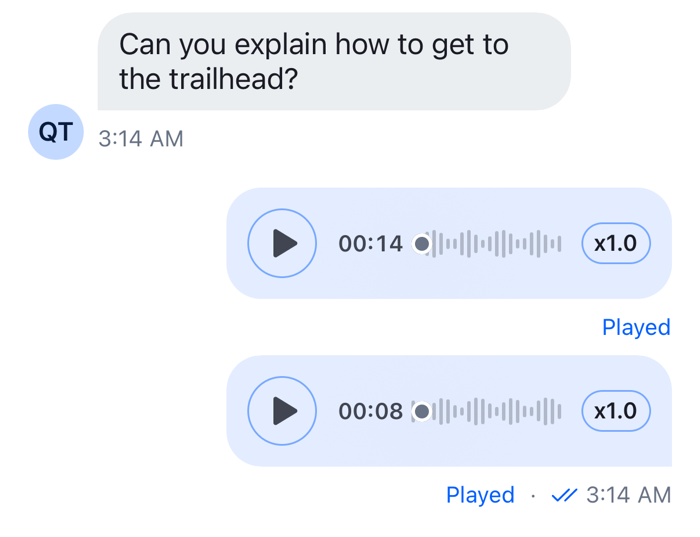
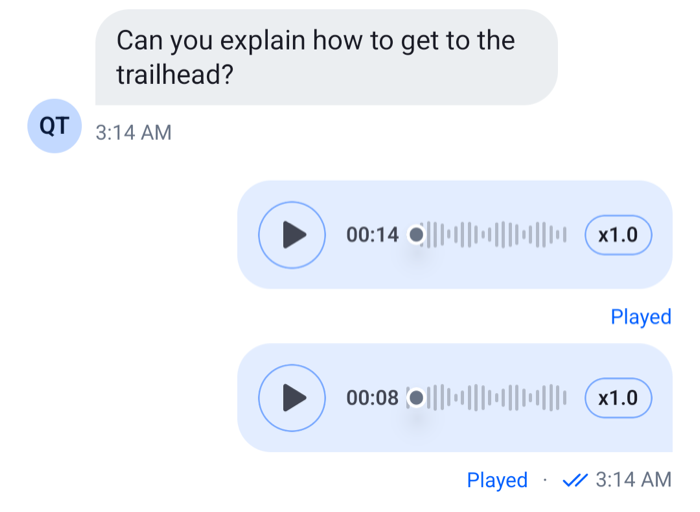
Under their own voice recording, audio file or video, the author sees "Played" once the other member played it, in a channel with exactly two members. In any other channel it reads "Played by" and how many members played it, up to "Played by 99+". The label sits in the footer before the delivery status, separated from it by a dot. It shows up while the channel is open, as soon as someone plays the message, and nothing shows until someone has.

A message that isn't the last of its group has no footer, so it shows the label alone, without the delivery status and the time.

<table>
  <tr>
  <td align='center' width='50%'>

![Played under an earlier voice recording, and Played, the double check and the time under the last one, on iOS](https://getstream.io/docs-assets/images/f6712d2be9ed.png)

  </td>
  <td align='center' width='50%'>

![Played under an earlier voice recording, and Played, the double check and the time under the last one, on Android](https://getstream.io/docs-assets/images/882642445179.png)

  </td>
  </tr>
</table>

The recipient marks a message by playing it: a voice recording or an audio file in the message list, or a video in the image gallery. A play counts once the media is playing, after any download and buffering, not when the user presses play. Previews in the composer and the user's own messages are never marked. With `autoPlayVideo` on `OverlayProvider`, a video the gallery starts by itself counts as a play too. Only the video on screen plays.

## How it works across the layers

- **State.** `channel.markMessagePlayed(messageId)` sends the `played` mark. It sends nothing when `channel.config.markTypes` doesn't list `played` or the user lacks the `send-message-mark` capability, and, for a message the client holds, when it's the user's own message or one they already marked. With offline support, a mark sent without a connection is queued and sent on reconnect. The `message.mark_added` event updates the message: the count in `mark_groups.played` on the author's copy, and `own_marks` on the copy of the member who played it. [Message marks](https://getstream.io/chat/docs/react-native/message-marks/) covers the API and the server side.
- **UI.** The SDK's players report when playback advances. `AudioAttachment` and the image gallery's video give their player a callback, which the player calls on each progress report until it returns `true`. The callback calls `handlePlaybackStarted` from `ChatConfigProvider`, or marks the message when there is none. `MessageFooter` renders the `MessageMark` key with the count.
- **Layout.** `OverlayProvider` renders the image gallery, outside your screens, so `ChatConfigProvider` goes above `OverlayProvider` for its videos to see your handler.

### When a play counts

- A player asks while it plays, on each progress report past the start, and stops asking once the answer is `true`. A paused player doesn't report, and a seek reports the new position.
- A player keeps its answer for as long as it lives. The image gallery discards its players when it closes, and an audio player goes when its channel screen unmounts, so a new player asks again. `markMessagePlayed` skips a message the user already marked, and the server ignores a repeat mark, so the label never counts a user twice.
- A video the gallery doesn't show doesn't play, so the videos next to the one on screen don't count.

## Turning it on or off

Marks are on where both of these hold:

1. Stream has enabled marks for your app. [Contact support](https://getstream.io/contact/support/) to enable them.
2. The channel type lists `played` in `mark_types`, which you set from the server side. See [Enabling marks on a channel type](https://getstream.io/chat/docs/react-native/message-marks/#enabling-marks-on-a-channel-type).

There is no prop to set. The SDK reads `channel.config.markTypes`, and where it doesn't list `played`, playing sends nothing and no label shows. By default `played` applies to messages with an `audio`, `voiceRecording` or `video` attachment, in channels of up to 100 members. An [app-level policy](https://getstream.io/chat/docs/react-native/message-marks/#app-level-policy) changes both.

To keep showing the label but never mark from your app, return `true` from `handlePlaybackStarted` without calling `markPlayed`. To hide the label, replace the `MessageMark` key with a component that renders `null`.

## Customizing

### Deciding what a play does

`handlePlaybackStarted` on `ChatConfigProvider` replaces what the SDK's players do when playback advances. It receives:

| Field        | Holds                                                                                               |
| ------------ | --------------------------------------------------------------------------------------------------- |
| `attachment` | the played attachment. Its `type` is `"audio"`, `"voiceRecording"` or `"video"`.                    |
| `markPlayed` | marks the message played, through `channel.markMessagePlayed()`                                     |
| `message`    | the message the attachment belongs to                                                               |
| `player`     | the `AudioPlayer` or `VideoPlayer`, with `position` and `duration` in milliseconds, and its `state` |

It returns whether the start is handled. `false` asks again on the next progress report, so a handler can wait for part of the media to play. Without a handler, the SDK calls `markPlayed()` and returns `true` on the first report. This one never marks audio files, and waits for 3 seconds of a video:

```tsx title="App.tsx"
import type { StreamChat } from "stream-chat";
import {
  Chat,
  ChatConfigProvider,
  OverlayProvider,
} from "stream-chat-react-native";
import type { HandlePlaybackStarted } from "stream-chat-react-native";

const handlePlaybackStarted: HandlePlaybackStarted = ({
  attachment,
  markPlayed,
  player,
}) => {
  if (attachment.type === "audio") {
    return true;
  }
  if (attachment.type === "video" && player.position < 3000) {
    return false;
  }
  markPlayed();
  return true;
};

// Declared once at module scope, so the value keeps its identity.
const chatConfig = { handlePlaybackStarted };

export const App = ({ client }: { client: StreamChat }) => (
  <ChatConfigProvider value={chatConfig}>
    <OverlayProvider>
      <Chat client={client}>{/* your navigation */}</Chat>
    </OverlayProvider>
  </ChatConfigProvider>
);
```

The value of `ChatConfigProvider` replaces its default as a whole. Pass `resizableCDNHosts` in the same object if you set it. Without it, image resizing uses its default, `['.stream-io-cdn.com']`.

[Playback telemetry](https://getstream.io/chat/docs/sdk/react-native/ui-cookbooks/message-list/playback-telemetry/) builds a handler that reports each play to analytics, with a different share of the media for each attachment type.

### The label

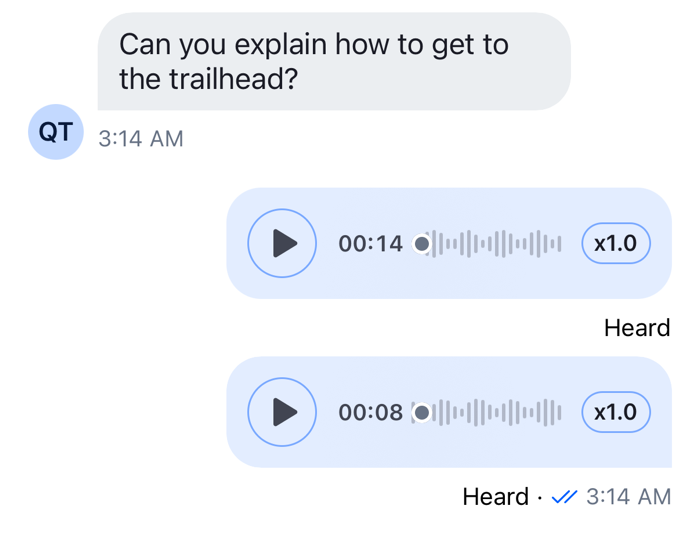
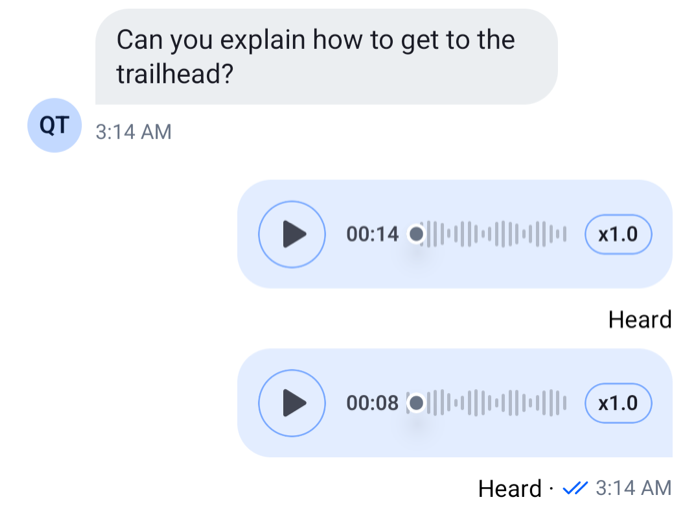
`MessageMark` is the override key for the label. It receives `isDirectChannel`, whether the channel has exactly two members, `playedCount`, how many other members played the message, and `showSeparator`, whether a delivery status follows it. `MessageFooter` renders it only when `playedCount` is above 0.

```tsx
import { Text } from "react-native";
import type {
  ComponentOverrides,
  MessageMarkProps,
} from "stream-chat-react-native";

const HeardBy = ({
  isDirectChannel,
  playedCount,
  showSeparator,
}: MessageMarkProps) => (
  <Text>
    {isDirectChannel ? "Heard" : `Heard by ${playedCount}`}
    {showSeparator ? " \u00b7" : ""}
  </Text>
);

// Pass to `WithComponents`, declared once at module scope.
export const overrides: ComponentOverrides = {
  MessageMark: HeardBy,
};
```

<table>
  <tr>
  <td align='center' width='50%'>

![Heard under an earlier voice recording, and Heard and a dot before the status of the last one, on iOS](https://getstream.io/docs-assets/images/241348df21b0.png)

  </td>
  <td align='center' width='50%'>

![Heard under an earlier voice recording, and Heard and a dot before the status of the last one, on Android](https://getstream.io/docs-assets/images/210a39685448.png)

  </td>
  </tr>
</table>

To change only how the default label looks, style `messageItemView.mark.container`, `messageItemView.mark.text` and `messageItemView.mark.separator` in the theme. The text uses the `chatTextRead` semantic token, the color of the read status. See [Theming](https://getstream.io/chat/docs/sdk/react-native/features/app-experience/theming/).

`Played` is `message.mark.played.text`, and `Played by {{playedCount}}` is `message.mark.playedBy.text`, where `playedCount` is the count or `99+`. See [Localization](https://getstream.io/chat/docs/sdk/react-native/features/app-experience/localization/).

[Played by list](https://getstream.io/chat/docs/sdk/react-native/ui-cookbooks/message-list/played-by-list/) makes the label open a list of every member who played the message, through `client.messageMarks`, which keeps the list current as members play it.

### A player of your own

A replaced `AudioAttachment`, or a player in your own components, marks nothing unless it says so. A player built on `useAudioPlayer` takes an `onPlaybackStarted` callback, which the player calls the same way it calls the SDK's own: on each progress report, until it returns `true`.

```tsx
import { useCallback } from "react";
import type { LocalMessage } from "stream-chat";
import { useAudioPlayer, useChannelContext } from "stream-chat-react-native";
import type { AudioAttachmentProps } from "stream-chat-react-native";

export const useMarkedAudioPlayer = ({
  item,
  message,
}: {
  item: AudioAttachmentProps["item"];
  message?: LocalMessage;
}) => {
  const { channel } = useChannelContext();
  const onPlaybackStarted = useCallback(() => {
    if (message) {
      channel.markMessagePlayed(message.id).catch(() => null);
    }
    return true;
  }, [channel, message]);

  return useAudioPlayer({
    duration: item.custom?.duration ?? 0,
    mimeType: item.custom?.mime_type ?? "",
    onPlaybackStarted,
    requester: message?.id,
    type: item.type,
    uri: item.asset_url ?? "",
  });
};
```

This callback marks directly, so it doesn't go through `handlePlaybackStarted`. Call your handler from it if you set one.

A player that doesn't use the SDK's players marks with `useMarkMessagePlayed`, once playback has started:

```tsx
import type { LocalMessage } from "stream-chat";
import {
  useChannelContext,
  useMarkMessagePlayed,
} from "stream-chat-react-native";

// `position` comes from your player's progress reports, in milliseconds.
export const usePlayedMark = (message: LocalMessage, position: number) => {
  const { channel } = useChannelContext();
  useMarkMessagePlayed({
    channel,
    hasStartedPlayback: position > 0,
    messageId: message.id,
  });
};
```

## Reference

- [Message marks](https://getstream.io/chat/docs/react-native/message-marks/): the API, `mark_types`, the app policy, the events and the limits.
- [Message UI components](https://getstream.io/chat/docs/sdk/react-native/component-reference/message/message-ui-components/#messagemark): `MessageMark` and `MessageFooter`.
- [Message hooks](https://getstream.io/chat/docs/sdk/react-native/reference/hooks/message-hooks/#usemarkmessageplayed): `useMarkMessagePlayed`.
- [Listing marks](https://getstream.io/chat/docs/react-native/message-marks/#listing-marks): every member who marked a message, a page at a time, with `client.messageMarks`.
- [Voice recordings and audio playback](https://getstream.io/chat/docs/sdk/react-native/features/rich-content/voice-recordings-and-audio-playback/): the audio players and `useAudioPlayer`.
- [Image gallery](https://getstream.io/chat/docs/sdk/react-native/component-reference/utilities/image-gallery/): the gallery's video players and `autoPlayVideo`.
- [Theme object](https://getstream.io/chat/docs/sdk/react-native/reference/theme/theme-object/#messageitemview): the `messageItemView.mark` keys.

---

For the most recent version of this documentation, visit [https://getstream.io/chat/docs/sdk/react-native/features/messaging/message-marks/](https://getstream.io/chat/docs/sdk/react-native/features/messaging/message-marks/).